If you have ever lugged a heavy five-gallon plastic bucket from your fish tank toward the bathroom tub, you have probably paused mid-step and wondered, can you use aquarium water for indoor houseplants instead of dumping it down the drain? Watching gallons of nutrient-packed water swirl into the sewer while you spend twenty bucks a bottle on synthetic houseplant food feels downright ridiculous.
Quick Takeaways: Using Fish Tank Water on Houseplants
-
Yes, freshwater tank water is liquid gold: Established freshwater aquarium water contains plant-ready nitrates, trace phosphorus, potassium, and beneficial microbes that act as a gentle, slow-release organic fertilizer.
-
Zero chlorine root shock: Because aquarium water is already dechlorinated and heated to around 74°F to 78°F, it protects sensitive tropical plant roots from cold tap water shock and chemical burn.
-
Never use saltwater or medicated water: Marine tanks, brackish setups, and hospital tanks treated with copper, antibiotics, or aquarium salt will rapidly dehydrate and kill potted plants.
-
Skip carnivore and low-mineral plants: High-output foliage plants like Monstera and Pothos thrive on fish water, whereas Venus flytraps and fussy Calatheas will suffer from mineral buildup.
Can You Use Aquarium Water for Indoor Houseplants Safely Every Week?
Yes, you absolutely can. In fact, once you understand how can you use aquarium water for indoor houseplants works in practice, you will probably never look at a bottle of commercial synthetic plant food the same way again.
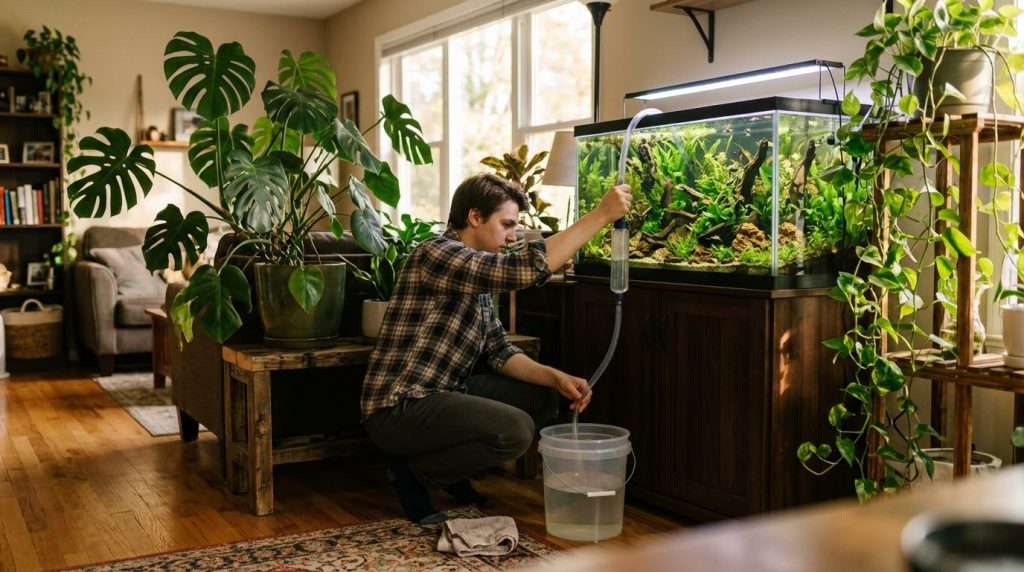
Think about it. Every single week, aquarists siphon out 20% to 30% of their tank volume to keep nitrate levels safe for their fish. That old water isn’t dirty trash—it is a living, pre-warmed probiotic tea brewed specifically for plant roots.
I started pouring wastewater from my 40-gallon planted community tank into my indoor jungle four winters ago (and believe me, my living room looked like a botanical testing lab). Within six weeks, my golden pothos vines doubled their internode growth and my peace lily pushed out leaves the size of dinner plates.
The Science Behind the Slop: NPK Ratios and the Nitrogen Cycle
Most gardening blogs just say “fish poop is good fertilizer” and leave it at that. Not quite. Fresh fish waste on its own is actually full of ammonia, which isn’t immediately helpful until your tank’s biological filter goes to work.
Inside a cycled aquarium filter, colonies of nitrifying bacteria (Nitrosomonas and Nitrobacter) convert fish waste and uneaten food from ammonia ($NH_3$) into nitrite ($NO_2^-$), and finally into nitrate ($NO_3^-$). Nitrate is the exact form of nitrogen that plant roots absorb fastest to build lush green stems and wide foliage (Source: [Insert Link to USDA/University Study]).
Here is how aquarium wastewater compares to standard tap water and commercial liquid fertilizer:
-
Nitrogen (N): Freshwater tank water typically contains 10 ppm to 40 ppm of nitrates, offering a steady, non-burning nitrogen boost every time you water.
-
Phosphorus (P): Decomposing fish food flakes and pellets release natural phosphates (usually 0.5 ppm to 2.0 ppm), which support sturdy root development and blooming.
-
Potassium (K) & Micronutrients: Fish waste is naturally low in potassium, iron, and magnesium, meaning tank water acts as a mild nitrogen-heavy tonic rather than a complete high-dose NPK fertilizer.
-
Beneficial Soil Microbes: Unlike sterile tap water treated with chlorine or chloramine, fish water introduces living microorganisms that colonize the rhizosphere and help break down organic potting matter.
-
Thermal Stability: Tropical fish tanks sit between 74°F and 80°F, matching the exact soil temperature tropical houseplants prefer during chilly winter months.
Look, it is not a 20-20-20 chemical blast. That is actually the best part. Because the nutrient concentration is naturally diluted, you get zero chemical salt crust on your terracotta pots and zero fertilizer root burn.
Water Parameters and Setup: What Tank Water Is Safe to Pour?
Before you start asking can you use aquarium water for indoor houseplants from just any fish bowl on your counter, we need to talk about water chemistry. Not every aquarium produces plant-safe water.
I learned this the hard way. A few years back, I treated myquarantine tank with aquarium salt for a mild ich outbreak and absentmindedly dumped a pitcher of that water into my favorite Boston fern. Dead in ten days.
Before watering your indoor plants, verify that your tank setup meets these strict safety benchmarks:
1. Freshwater Only (Zero Salt Tolerance)
Only collect water from pure freshwater aquariums—think bettas, guppies, tetras, goldfish, cichlids, or freshwater shrimp. Marine reef tanks, brackish puffer tanks, and freshwater tanks dosed with sodium chloride (aquarium salt) will destroy cellular osmosis in terrestrial plant roots.
2. Check Your pH and Hardness (GH/KH)
Most tropical houseplants absorb nutrients best when water pH sits between 5.5 and 6.8. If you keep African Cichlids in liquid-rock water with crushed coral and a pH of 8.4, pouring that alkaline water onto acid-loving plants will lock out iron and turn new leaves pale yellow.
3. Quarantine and Medicated Tanks Are Off-Limits
Never use water from a tank recently dosed with copper-based parasite killers, methylene blue, malachite green, erythromycin, or chemical algaecides. Copper and anti-fungal medications wipe out the beneficial mycorrhizal fungi living inside your potting soil.
4. Dechlorinator Safety Check
If you use a standard tap water conditioner like Seachem Prime or API Stress Coat during water changes, your water is 100% safe for ornamental houseplants. However, if you grow indoor kitchen herbs like basil, mint, or cherry tomatoes on a sunny windowsill, skip tank water treated with non-food-grade aquarium chemicals.
Step-by-Step Siphon and Watering Routine (The Mulm Method)
How you pull the water out of your aquarium changes how your plants react. If you just scoop water off the top of the tank with a coffee mug, you get clear, low-nutrient water. If you vacuum deep into the gravel, you pull up dark brown organic sludge called “mulm.”
Mulm is pure gold. Wait—let me qualify that. Undiluted mulm poured straight onto dense indoor potting soil can form a crusty, oxygen-blocking mud layer on top of your pot.
Follow this exact 5-step siphon and dilution workflow for mess-free indoor watering:
-
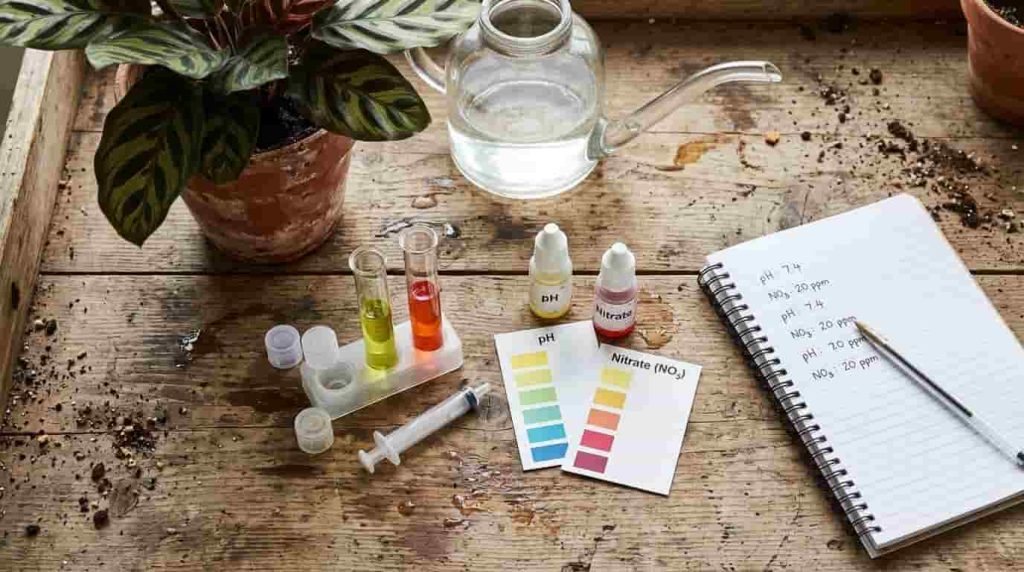
Test Nitrates Before Siphoning: Dip a test strip into your tank before starting your water change; an ideal reading for plant watering sits between 15 ppm and 40 ppm nitrate.
-
Vacuum the Substrate into a Dedicated Bucket: Run your gravel siphon through the bottom substrate to pull up settled fish waste and decayed aquatic leaves into a clean five-gallon bucket.
-
Swirl and Let Heavy Debris Settle for 5 Minutes: Allow coarse sand, snail shells, and heavy gravel bits to drop to the bottom of the bucket while keeping the nutrient-rich brown suspension afloat.
-
Dilute Thick Bottom Sludge 50/50: Pour the top three-quarters of the bucket directly into your watering can, then dilute the thick, muddy bottom quarter 1:1 with dechlorinated room-temperature water before using it.
-
Drench Until 15% Drains Through the Bottom: Pour slowly around the root zone—never splashing dirty tank water onto fuzzy plant leaves—until excess water flows freely into the drainage saucer, then empty the saucer after 20 minutes.
[Internal Link: Check out our guide on Bottom Watering Indoor Plants Pros and Cons]
Adjusting Your Soil Mix for Organic Fish Water
Here is the thing nobody tells you when you search can you use aquarium water for indoor houseplants on forums. Fish tank water carries microscopic suspended solids—fish waste particles, biofilm, and broken-down fish food.
If your houseplants are sitting in cheap, heavy, peat-based supermarket potting soil, those tiny organic particles will clog the microscopic air pockets in the dirt. Over six months, the soil compacts into a soggy brick. Root rot follows fast.
When you feed plants with organic aquarium water, your soil mix needs extra aeration so oxygen can reach the roots and soil microbes can digest the fish waste efficiently (Source: [University Extension Soil Aeration Guide]).
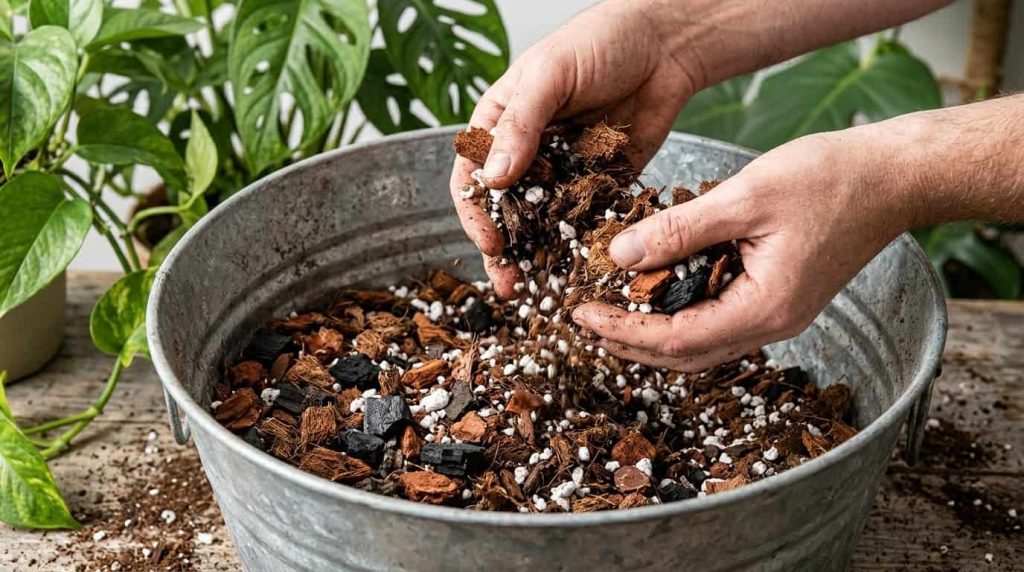
Use this high-oxygen indoor soil formula for fish-watered houseplants:
-
50% High-Quality Coco Coir or Peat Base: Holds steady moisture and houses the beneficial bacteria introduced from your aquarium filter.
-
25% Coarse Perlite or Pumice: Creates permanent air channels so suspended organic particles from tank water never suffocate fine root hairs.
-
20% Chunky Orchid Bark (Fir Bark): Gives epiphytic roots (like Monstera, Philodendron, and Anthurium) structure to grip while preventing soil compaction.
-
5% Horticultural Charcoal: Acts as a natural odor filter and buffers excess organic acids inside the pot.
Synchronizing Lighting and Seasonal Watering Schedules
Pouring nitrogen-rich fish water onto a plant sitting in a dark corner is a recipe for disaster. Why? Because fertilizer does not make a plant grow—light makes a plant grow, and fertilizer simply provides the building blocks.
When a plant receives high nitrogen from aquarium water without enough photons to drive photosynthesis, it produces weak, floppy, pale green stems. Gardeners call this etiolation, or leggy growth.
Match your aquarium watering schedule to your home’s lighting and seasonal shifts:
-
Spring and Summer (Active Growth Phase): When your plants receive 10 to 14 hours of bright indirect sunlight (or sit 12 inches below a full-spectrum LED grow light), you can use aquarium water for every single watering session.
-
Autumn Transition: As daylight hours shrink in October, alternate your watering sessions—use aquarium water on week one, then plain dechlorinated water on week two.
-
Winter Dormancy (Low Light Phase): Wait. Even though warm aquarium water feels great on plant roots in January, most indoor plants slow their metabolism in winter. Unless your plants sit under dedicated 12-hour grow lights, scale back fish tank water to once a month in winter so unused nitrates don’t accumulate in the pot.
-
Supplemental Potassium Boost: Because fish water is naturally low in potassium, mix in a quarter-strength dose of liquid kelp or organic potassium sulfate once every 6 to 8 weeks during summer for stronger cell walls.
Crop and Plant Choices: Which Houseplants Love (or Hate) Fish Water?
Not all indoor plants share the same appetite. While answering can you use aquarium water for indoor houseplants, you have to separate the heavy feeders from the mineral-sensitive divas.
Let’s break down exactly which plants in your living room should get the fish bucket and which ones should never touch it.
Heavy Feeders That Thrive on Aquarium Water
-
Aroids (Monstera deliciosa, Philodendrons, Pothos, Syngonium): These fast-growing tropical foliage plants devour nitrogen and reward you with massive fenestrated leaves.
-
Peace Lilies (Spathiphyllum) and Spider Plants: Both species love consistent moisture and mild organic feeding, plus aquarium water lacks the tap water fluoride that turns spider plant tips brown.
-
Ficus Varieties (Fiddle Leaf Fig, Rubber Plant, Weeping Fig): High-nitrogen tank water supports dark, glossy leaf production during spring and summer flushes.
-
Semi-Hydro and Riparium Cuttings: Rooting pothos, tradescantia, or monstera cuttings directly in the top of your aquarium (with leaves kept strictly above the waterline) accelerates root growth thanks to warm, oxygenated water from the air stone.
Sensitive Plants That Hate Aquarium Water
-
Carnivorous Plants (Venus Flytraps, Pitcher Plants, Sundews): Zero tolerance. These bog plants evolved in nutrient-barren environments; the nitrates and minerals in fish water will burn their roots and kill them within weeks. Use distilled or rainwater only.
-
Succulents, Cacti, and Jade Plants: Desert plants prefer lean, low-nitrogen soil. Feeding them nitrogen-rich fish water causes soft, bloated, watery tissue that rots or splits easily.
-
Calatheas, Marantas, and Stromanthe: Proceed with extreme caution. If your aquarium is filled with hard tap water (high GH/TDS), the dissolved calcium and magnesium will still crisp the edges of prayer plant leaves, even if the chlorine is gone.
-
Edible Indoor Salad Greens and Microgreens: Because raw fish waste can occasionally harbor bacteria like Salmonella or Mycobacterium marinum, never pour tank water over raw-eaten leafy greens or herbs (Source: [University Food Safety Extension Study]).
Pest Control and Odor Troubleshooting Indoors
Let’s be honest for a second. Nobody wants their living room smelling like low tide at a bait shop. And nobody wants a cloud of tiny black flies hovering around their coffee cup.
Those are the two biggest fears plant parents bring up when asking can you use aquarium water for indoor houseplants. Fortunately, both issues only happen when you make a simple watering mistake.
1. Eliminating the “Fishy” Smell Indoors
Healthy, well-filtered aquarium water should never smell like rotting fish—it should smell faintly earthy, like a forest floor after rain. If your houseplants smell fishy after watering, one of two things went wrong: either you poured raw, undiluted bottom sludge that stayed stranded on top of the soil, or your pot lacks drainage holes and went anaerobic.
Always let healthy soil absorb the water completely. If any faint earthy scent lingers, it vanishes within 30 to 45 minutes once the top layer of bark and perlite drains.
2. Stopping Fungus Gnats Before They Start
Here is the real trap. Fungus gnat larvae (Bradysia species) don’t just eat plant roots; they feast on decaying organic matter and fungi in the top two inches of wet soil.
When you top-water with aquarium water containing microscopic bits of uneaten fish flake and organic waste, you are laying out an all-you-can-eat buffet for fungus gnats. Beat them effortlessly with three habits:
-
Use the Bottom-Watering Method: Pour your strained aquarium water into a deep tray and let your nursery pots sit in it for 20 minutes to soak water upward, keeping the top inch of soil dry and gnat-free.
-
Add a 1/2-Inch Top Dressing: Cover the top of your potting mix with coarse horticultural sand or fine aquarium gravel so adult gnats cannot lay eggs in the organic matter.
-
Inoculate with BTI (Mosquito Bits): Steep Bacillus thuringiensis israelensis (BTI) granules in your watering can once a month; it is 100% organic, harmless to plants, and wipes out gnat larvae on contact.
Read: How to Water Succulents Indoors: The Ultimate Survival Guide
Frequently Asked Questions (FAQ)
Can you use aquarium water for indoor houseplants every time you water?
Yes, can you use aquarium water for indoor houseplants every time you water during the active spring and summer growing seasons is one of its biggest perks, provided your tank is a regularly maintained freshwater setup. Because routine water changes keep nitrate levels mild (around 10 to 40 ppm), the water feeds your plants gently without causing fertilizer burn. In winter, cut back to using tank water once a month while plant growth slows down.
Does fish tank water make indoor plants smell bad?
No, water from a healthy, properly cycled freshwater aquarium only has a mild, earthy scent that disappears within 30 minutes of soaking into well-draining potting mix. Foul odors only occur if you pour thick, undiluted gravel sludge onto compact soil or use pots without drainage holes, which traps stagnant water and triggers anaerobic bacteria.
Do I still need to fertilize houseplants if I use aquarium water?
While aquarium water provides an awesome supply of nitrogen, beneficial bacteria, and trace phosphorus, it is naturally low in potassium and micronutrients like iron and magnesium. For heavy-feeding or flowering houseplants, supplement your aquarium watering routine with a half-strength balanced liquid fertilizer or liquid kelp once every 6 to 8 weeks during summer.
Is water from a Betta bowl or goldfish tank better for plants?
Both work great, as long as the water is freshwater and free of aquarium salt or medications. Goldfish produce a significantly higher bioload (more waste and higher nitrates) than a single betta fish, making goldfish tank water a much richer nitrogen tonic that may need a quick 50/50 dilution with plain dechlorinated water if you haven’t cleaned the tank in weeks.
Final Thoughts on Turning Tank Waste into Lush Foliage
So, can you use aquarium water for indoor houseplants to build a thriving, low-cost indoor jungle? Without a single doubt, yes.
By swapping cold, chlorinated tap water for warm, microbe-rich freshwater from your routine tank changes, you save money on synthetic fertilizers, conserve gallons of household water, and give your tropical plants the exact gentle nutrition they crave. Grab your siphon next water-change day, strain out the heavy sludge, and let your houseplants drink up the liquid gold.