Everyone calls snake plants indestructible right up until the afternoon a tall, architectural blade keels sideways onto the living room rug. You touch the base, and it feels like a warm, wet sponge. Knowing how to save a dying snake plant comes down to acting the exact day you spot that slump—not waiting two more weeks to see if it perks back up.
It won’t perk back up on its own. Dracaena trifasciata (still sold everywhere under its old name, Sansevieria trifasciata) stores water inside dense, fibrous leaves and underground rhizomes. Because of that built-in reservoir, a snake plant can rot beneath the soil line for six weeks before a single blade turns yellow. By the time the foliage looks rough, the emergency is already underway.
Direct Rescue Answer: To save a dying snake plant, pull it out of its pot immediately and inspect the underground rhizomes. Cut away every brown, black, or mushy root and soft leaf base using rubbing-alcohol-sanitized shears, let the healthy orange-tan rhizomes air-dry for 24 to 48 hours, and repot tightly into dry, gritty cactus mix inside a smaller terracotta pot with a drainage hole. Hold water for 5 to 7 days. If the entire rhizome is mushy, chop healthy green leaf tops with an inverted V-cut, callus them for 3 to 5 days, and propagate fresh plants from cuttings.
First, Check the Base: A 60-Second Triage Before You Touch the Scissors
Grab the base of the worst-looking leaf between your thumb and forefinger and give it a gentle squeeze. That single physical test tells you more than staring at the tips ever will. Most apartment plant owners guess wrong here because underwatered snake plants and overwatered snake plants both lean, curl, and look generally miserable.
| What You See & Feel | What’s Actually Happening | Your Immediate Move |
| Yellow, soft, or foul-smelling leaf base that pulls straight out of the soil | Fungal or bacterial root/rhizome rot from soggy mix and low airflow | Unpot today. Cut out all rot and air-dry the survivors. |
| Wrinkled, vertical creases running up firm, dry, curling blades | Severe dehydration—or roots rotted away so badly the plant can no longer drink | Check the soil first. Bone-dry brick means soak; damp soil means rot surgery. |
| Water-soaked, translucent, olive-grey patches overnight | Cold damage from temps dipping below 50°F against winter window glass | Move 3–4 feet away from the pane. Don’t water or fertilize until warm growth resumes. |
| Tall green swords flopping outward while still firm at the soil line | Chronic low light stretching weak tissue, or soil too loose to anchor tall blades | Move closer to a bright window and repot into a heavier container. |
| Dry, crispy brown tips on otherwise solid green blades | Tap water fluoride/salts, physical bumping in tight hallways, or erratic watering | Leave the leaf intact; switch to filtered or rainwater if tips spread. |
| Tiny white cottony tufts wedged deep inside the central rosette | Mealybugs feeding on sap in stagnant indoor air | Isolate immediately and swab every crevice with 70% isopropyl alcohol. |
Here is the physiology quirk that trips people up. Snake plants run on Crassulacean Acid Metabolism (CAM), meaning they keep their leaf pores (stomata) tightly shut during the day to avoid losing moisture and open them at night to pull in carbon dioxide. In a dim US apartment—say, ten feet back from a north-facing window—that metabolic engine slows to a crawl. The roots barely drink a few teaspoons of water per week. Pour a full cup of water into dense nursery peat under those conditions, and the soil stays cold and airless for three weeks straight. Roots suffocate first; rot fungi move in second.
How to Save a Dying Snake Plant From Root Rot (Step-by-Step Surgery)
Nine times out of ten, when someone asks how to save a dying snake plant, root rot is the culprit. Waiting for the pot to dry out rarely saves it once leaves turn yellow at the soil line. Pathogens keep marching sideways through the underground rhizome even while the top inch of mix feels crumbly.
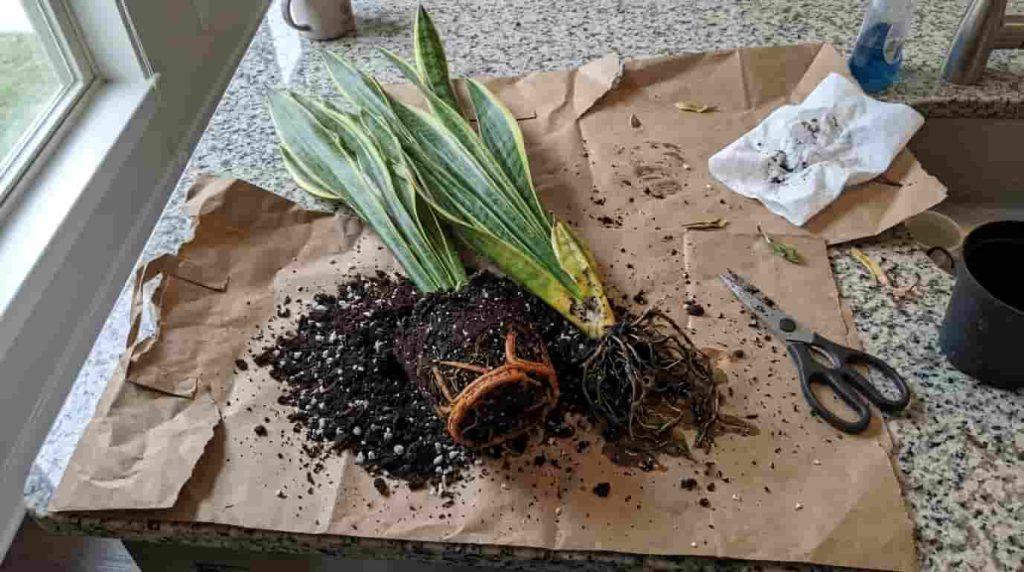
Spread a split-open trash bag or old newspaper across your kitchen counter or bathroom floor. Do not rinse potting soil directly down an apartment sink drain unless you enjoy explaining to your super why perlite and bark chips turned the P-trap into concrete. Fill a five-gallon bucket or large mixing bowl with lukewarm tap water instead.
-
Ease the entire plant out of its pot. Tip the container sideways, tap the rim gently against your palm, and slide the rootball free. If it’s wedged tight inside an old nursery pot, run a butter knife around the inside wall rather than yanking on the blades.
-
Strip off every bit of old potting mix. Break soggy clumps away with your fingers, then swish the roots in your water bucket so you can actually see the tissue. Toss that old soil straight into the trash—never reuse rot-contaminated mix on another houseplant.
-
Run the squeeze test on roots and rhizomes. Healthy snake plant roots look whitish, tan, or pale orange and feel crisp. Healthy rhizomes—the chunky, tuber-like horizontal stems connecting the leaves—feel as solid as a fresh carrot. Anything black, grey, hollow, stringy, or smelling like damp basement mulch has to go.
-
Sterilize your blades and cut clean. Wipe pruning shears or a sharp kitchen knife with 70% rubbing alcohol. Slice off rotted roots back to firm white tissue. If a blade is green at the top but mushy at the soil line, sever it cleanly at the rhizome, and wipe your knife between cuts if you slice through active rot so you don’t smear bacteria into healthy flesh.
-
Skip the internet pantry tricks. You’ll see plenty of blogs recommending crushed garlic cloves buried in the soil or overnight banana-peel tea to “boost” a sick plant. Skip both. In a closed apartment without outdoor wind or soil microbes, rotting food scraps ferment fast, grow fuzzy white mold, and turn your rescue pot into a breeding factory for pests. If you’re already noticing tiny black flies hovering around that wet soil—which almost always show up right alongside early root rot—check out our guide on [How to Get Rid of Fungus Gnats With Hydrogen Peroxide Ratio: The Exact 1:4 Mix and Schedule That Works] to knock down larvae safely before they chew on tender new roots.
-
Optional peroxide rinse, then real drying time. If rot was aggressive, dip only the trimmed rhizomes and healthy roots into standard 3% household hydrogen peroxide for about 30 seconds—you’ll see mild fizzing on remaining dead cells—then pat dry with a clean paper towel. Now set the bare-root plant on a dry towel in a warm, bright spot out of harsh direct sun for 24 to 48 hours.
Don’t rush that last step. Many quick tutorials tell you to wait 30 minutes and shove the plant straight back into soil. Thirty minutes isn’t enough for fleshy rhizome cuts to form a dry protective callus. Giving those wounds a full day or two in open air seals the doorway against fresh rot fungi—and a succulent snake plant won’t mind being bare-root on your counter for two days at all.
The Fork in the Road: Repotting Survivors vs. Emergency Leaf Propagation
Once the rot is gone, look honestly at what’s sitting on your paper towel. Your next move splits down one of two paths depending on whether the underground rhizome survived.
Path A: You Still Have Firm Rhizomes and Healthy Roots
Even if you lost half the root mass, a solid chunk of orange-tan rhizome with two or three intact leaves can rebound completely. Your biggest trap right now is reusing the original pot.
Put a shrunken rootball back into an oversized 8-inch glazed ceramic pot, and you’ve built a swamp all over again. Unused soil around the perimeter holds stagnant water for weeks. Downsize until there is only about 1 inch of clearance between the surviving root mass and the pot wall. Snake plants actually prefer snug quarters; as Penn State Extension: Snake Plant Care & Division Guide notes, these plants tolerate being rootbound for years and only need a heavier container—like unglazed terracotta—to keep tall upright blades from toppling over when the mix dries out.
Unglazed terracotta is your best friend during rehab. Clay walls breathe, pulling excess moisture outward through evaporation in half the time of plastic or glazed ceramic. If you love a decorative ceramic cachepot, keep the snake plant in a snug plastic nursery pot with generous bottom holes, take it to the sink to water, let it drain completely for 15 minutes, and drop it back inside the dry cachepot.
Build a mix that drains in seconds rather than minutes. Standard bagged indoor potting soil holds far too much water in apartment conditions. Mix:
-
2 parts coarse cactus/succulent soil (or standard potting mix)
-
2 parts chunky perlite or pumice (pumice won’t float to the top when you water)
-
1 part fine pine bark fines or coarse horticultural sand (skip fine play sand—it turns into cement)
According to the NC State Extension Plant Toolbox: Dracaena trifasciata Cultural & Toxicity Profile, Dracaena trifasciata comfortably handles a wide neutral-to-alkaline soil pH range between 6.0 and 8.0, as long as drainage stays sharp. Plant the rhizomes at the exact same depth they sat before—burying the green leaf crowns too deep traps water in the central sheath and restarts rot.
Put the watering can down after repotting. Wait 5 to 7 full days before giving a light first drink so microscopic root hairs bruised during repotting can heal. Don’t panic if one older outer blade finishes turning yellow during week two; mild transplant stress happens even after a clean rescue. If you want to tell the difference between normal shedding and a botched repot, read through [Indoor Plant Leaves Turning Yellow After Repotting: Diagnostic Triage & Recovery Guide] before you dig it back up.
Path B: The Entire Rhizome Is Mush (Leaf-Cutting Reset)
Sometimes you unpot the plant and every single bit below the soil line collapses into grey sludge. That doesn’t mean the plant is trash. As long as you have 4 to 8 inches of firm, green, healthy upper leaf blade left, you can grow an entire new colony from leaf cuttings.
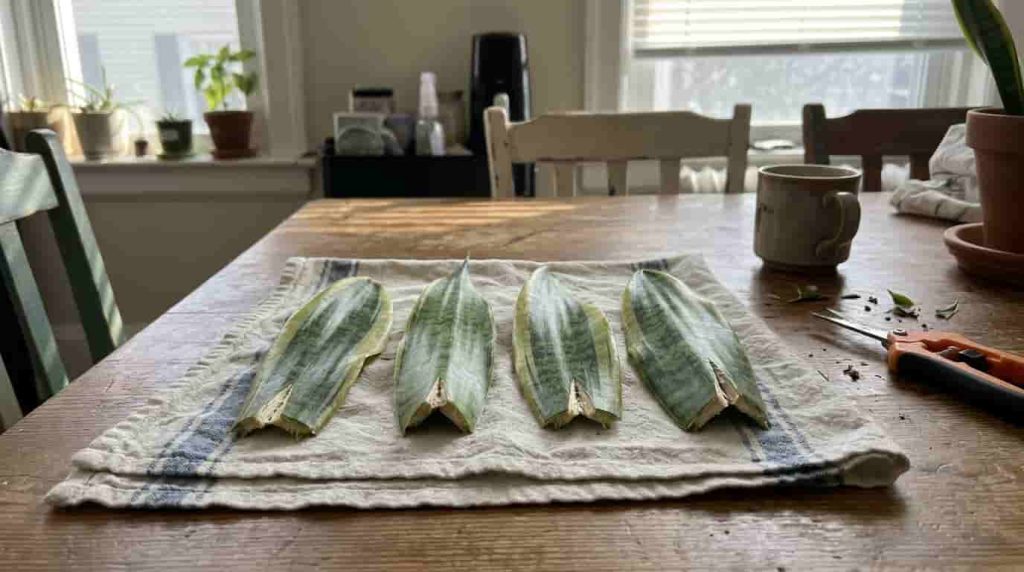
Slice well above the yellow, soft zone—give yourself at least an extra inch of clean green margin so hidden fungal hyphae don’t hitch a ride. Make an inverted V-cut (a chevron notch pointing upward) at the bottom edge of each cutting. Why bother with the V-shape? Two practical reasons: it widens the surface area where roots emerge, and it makes it impossible to accidentally stick a leaf segment into soil upside down. Snake plant cells are polar; plant a cutting upside down and it will sit there stubbornly until it rots.
Lay your trimmed cuttings flat on a dry shelf or kitchen towel for 3 to 5 days until the cut edges shrink slightly and feel leathery to the touch.
From there, you have two choices:
-
Dry-leaning gritty soil: Stick the notched bottom 1.5 inches deep into a small terracotta pot filled with half cactus mix and half perlite. Water lightly once every 10 to 14 days—just enough to slightly dampen the mix near the base, never soggy.
-
Shallow water glass: Stand cuttings upright in a clean narrow jar with just 1 inch of room-temperature filtered water covering the inverted V-notch. Swap the water completely every 5 to 7 days so oxygen stays fresh and slime never builds up.
Water propagation lets you watch white roots sprout in 4 to 6 weeks without guessing, though soil-grown roots transition faster without transplant shock. Either way, expect patience. New baby pups usually take 2 to 4 months to break through.
One genetic quirk almost nobody warns apartment growers about: if your dying plant was a yellow-edged variegated cultivar like Dracaena trifasciata ‘Laurentii’, leaf cuttings will not keep those golden stripes. The pups that grow from leaf cuttings revert to solid green mottled blades (the classic wild-type pattern). Only dividing an intact rhizome preserves the yellow borders. You’ll still save your plant’s lineage—just expect a green makeover.
When It Isn’t Root Rot: Cold Drafts, Thirst, and Hidden Pests
Not every collapsing snake plant drowned. Before you blame yourself for overwatering, check three sneaky apartment hazards that mimic rot from a distance.
Winter Window Chill and AC Vents
Tropical western Africa is home turf for Dracaena trifasciata, and its cells start breaking down when temperatures dip below 50°F. Your apartment thermostat might read a cozy 69°F on the hallway wall, yet a leaf pressing directly against single-pane glass during a January cold snap in Chicago, Minneapolis, or New York can easily drop to 42°F overnight.
Cold damage looks eerily like rot—soft, translucent, dark olive patches that later collapse into papery tan scars. The giveaway? Cold scars usually appear mid-blade or along the side facing the window or blasting window AC unit, while the soil stays dry and the rhizome remains solid. Slide the pot two or three feet back from winter glass, keep foliage off the panes, and trim off completely liquefied blades. Partially scarred green leaves look rough, sure, but leave them attached until new pups emerge—they’re still making food for recovery.
Severe Dehydration vs. Hydrophobic Potting Mix
Yes, you really can underwater a snake plant, especially when a potted plant sits three feet from a hissing cast-iron steam radiator all winter. When a snake plant runs out of stored water, its stiff vertical blades develop deep lengthwise wrinkles, curl inward like taco shells, and droop softly without turning yellow or slimy.
Here is the catch: sometimes you did water it, yet it’s still bone-dry inside. Old peat-based nursery mix dries into a hydrophobic puck that shrinks away from the pot walls. When you pour water on top, it races straight down the gap along the sides and floods the saucer in three seconds while the inner roots stay dry as chalk.
Fix hydrophobic mix by bottom-soaking. Set the potted plant into a kitchen sink or mixing bowl filled with 2 inches of lukewarm water for 30 to 45 minutes until the top surface darkens slightly. Let it drain fully on a dish rack before moving it back. If the roots are healthy, wrinkled leaves usually plump back out over 5 to 10 days.
Mealybugs, Spider Mites, and Scale Hiding in the Rosette
Tough, waxy foliage keeps most houseplant bugs away, which makes people forget to look closely when leaves start yellowing or twisting strangely. Shine your phone flashlight straight down into the tight V-shaped pockets where new blades emerge.
That sheltered crevice is prime real estate for longtailed mealybugs—tiny oval insects wrapped in waxy white fuzz—as well as flat brown armored scale and fine spider mite webbing. Left alone in dry apartment air, mealybugs stunt new shoots and drip sticky honeydew that grows black sooty mold. Skip harsh garden sprays indoors; dab every visible bug with a cotton swab soaked in 70% rubbing alcohol, then follow our full breakdown on [Rubbing Alcohol on Succulents for Mealybugs: How to Kill Pests Without Burning Leaves] so you clear hidden eggs without scorching the plant’s protective waxy cuticle.
How to Save a Dying Snake Plant Long-Term: Apartment Light, Water, and Recovery Math
Rescuing the plant today only buys you time. Keeping it alive past next winter means fixing the indoor microclimate that broke it in the first place.
Let’s clear up the single biggest houseplant marketing lie ever printed on a plastic nursery tag: snake plants are not “low-light lovers.” They tolerate dim corners slowly while starving in slow motion. Put a recovering snake plant in a dark apartment bedroom measuring 40 to 60 foot-candles, and it won’t push a single new root for six months—meaning any water you pour in just sits there waiting to rot it again.
Move your rehab patient into bright indirect light—ideally within 2 to 5 feet of an unobstructed east- or south-facing window, or right on a bright west sill with sheer curtains softening harsh summer afternoon glare. In real measurement terms, aim for 200 to 600 foot-candles (roughly 40 to 120 µmol/m²/s PPFD on a light meter app). Under decent light, the plant actually drinks what you give it, dries out its pot on a predictable schedule, and pushes thick, upright swords that don’t flop over.
Watering by the calendar is what kills apartment snake plants. A 5-inch terracotta pot sitting near a sunny June window in Austin might dry bone-dry in 12 days; the exact same pot in a dim Seattle apartment during November might stay damp for 6 weeks. Ditch the schedule and push a dry wooden chopstick all the way to the bottom of the pot. Pull it out. If it feels cool or comes up with dark soil specks clinging to the tip, walk away and check again next week. Only soak the pot once the mix is 100% dry all the way to the drainage hole—and dump out any runoff sitting in the saucer ten minutes later.
| Recovery Window | What You Should Actually Expect | What NOT to Do |
| Weeks 1–2 | Zero visible growth. One stressed outer leaf might finish yellowing and pull loose. | Don’t water twice “just to help it settle,” and don’t tug on leaves to check roots. |
| Weeks 3–6 | Remaining blades stay upright and firm. Subtle root anchoring begins underground. | Don’t add liquid fertilizer yet—damaged roots burn easily from fertilizer salts. |
| Months 2–4 | Gentle tug meets real resistance as fresh white roots grip the gritty mix. First pale green shoot tips may poke up if light is bright. | Don’t repot into a bigger container just because it looks stable. |
| Months 4+ | Active pups unfurling during spring/summer. Resume half-strength balanced houseplant fertilizer once monthly during active growth. | Don’t return the pot to the dark hallway corner where it got sick. |
One quick safety note while you’re nursing a beat-up plant on apartment counters: snake plants contain natural defense compounds called saponins. According to the ASPCA Animal Poison Control: Snake Plant Toxicity Profile, every part of Dracaena trifasciata is toxic to cats and dogs if chewed, triggering nausea, vomiting, and diarrhea. Freshly trimmed leaf cuttings drying on a kitchen towel look awfully tempting to curious cats, so keep your callusing blades tucked inside a closed bathroom or on a high shelf pets truly cannot reach.
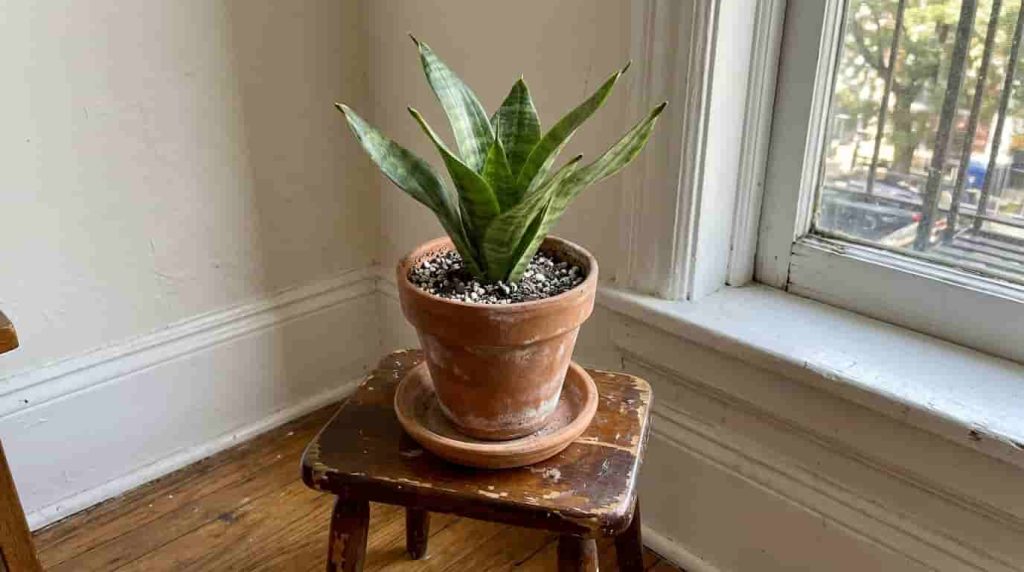
Once you understand that these plants rot from stagnant wetness and dim corners rather than neglect, knowing how to save a dying snake plant stops feeling like guesswork. Give those surviving rhizomes clean surgery, real drying air, chunky soil, and an actual window view—then step back and let slow desert genetics do the rest.
How to Save a Dying Snake Plant: Common Apartment Questions (FAQ)
Can a flopped or bent snake plant leaf ever stand back up?
Once a blade bends sharply or creases, the internal fibers are permanently snapped, so it won’t straighten back out on its own. If the base is still firm and green, you can either prop it lightly with a bamboo stake for looks or snip it cleanly at the base and propagate the healthy upper section into a new plant. If the base feels soft or yellow, cut it off right away so rot doesn’t spread to healthy neighbors.
How long after repotting a dying snake plant should I wait to water?
Wait 5 to 7 full days after repotting salvaged rhizomes into dry gritty soil. Handling roots always creates tiny invisible tears; pouring water into fresh soil right away invites rot bacteria straight into those open micro-wounds. Let the plant rest dry first, then give a moderate watering only after a week has passed.
Can you save a dying snake plant that has zero roots left?
Yes, as long as you still have either a firm piece of underground rhizome or at least 4 inches of solid, healthy green leaf blade. Trim away every trace of soft brown decay, let the clean cuts callus in open air for 2 to 5 days, and reroot the healthy tissue in gritty cactus mix or an inch of fresh water. Expect 4 to 8 weeks before new white roots show up.
Should I cut off yellow leaves when learning how to save a dying snake plant?
Yes—a yellow snake plant blade will never turn green again. Pull or slice yellowed, mushy leaves right down at the rhizome so you aren’t leaving decaying tissue sitting against healthy crowns. If only the top inch of a blade has a dry crispy brown tip, leave the rest of the green leaf intact so the plant keeps its solar panels while rebuilding roots.
Why did my snake plant die even though I barely watered it?
Two common apartment scenarios cause this. First, if the plant sat in a very dim room inside dense nursery peat, even watering once a month can keep the bottom third of the pot constantly wet until roots suffocate. Second, old peat mix sometimes dries into a water-repelling brick, meaning your light splashes ran straight down the pot edges without ever reaching the roots inside.
How often should I water my rescued snake plant during winter in a heated apartment?
Most indoor snake plants only need water every 4 to 8 weeks between November and March, depending on pot size and how close they sit to radiators or sunny windows. Never water on a fixed weekly schedule; push a wooden skewer to the bottom of the pot and only soak it once the entire root zone feels completely dry.