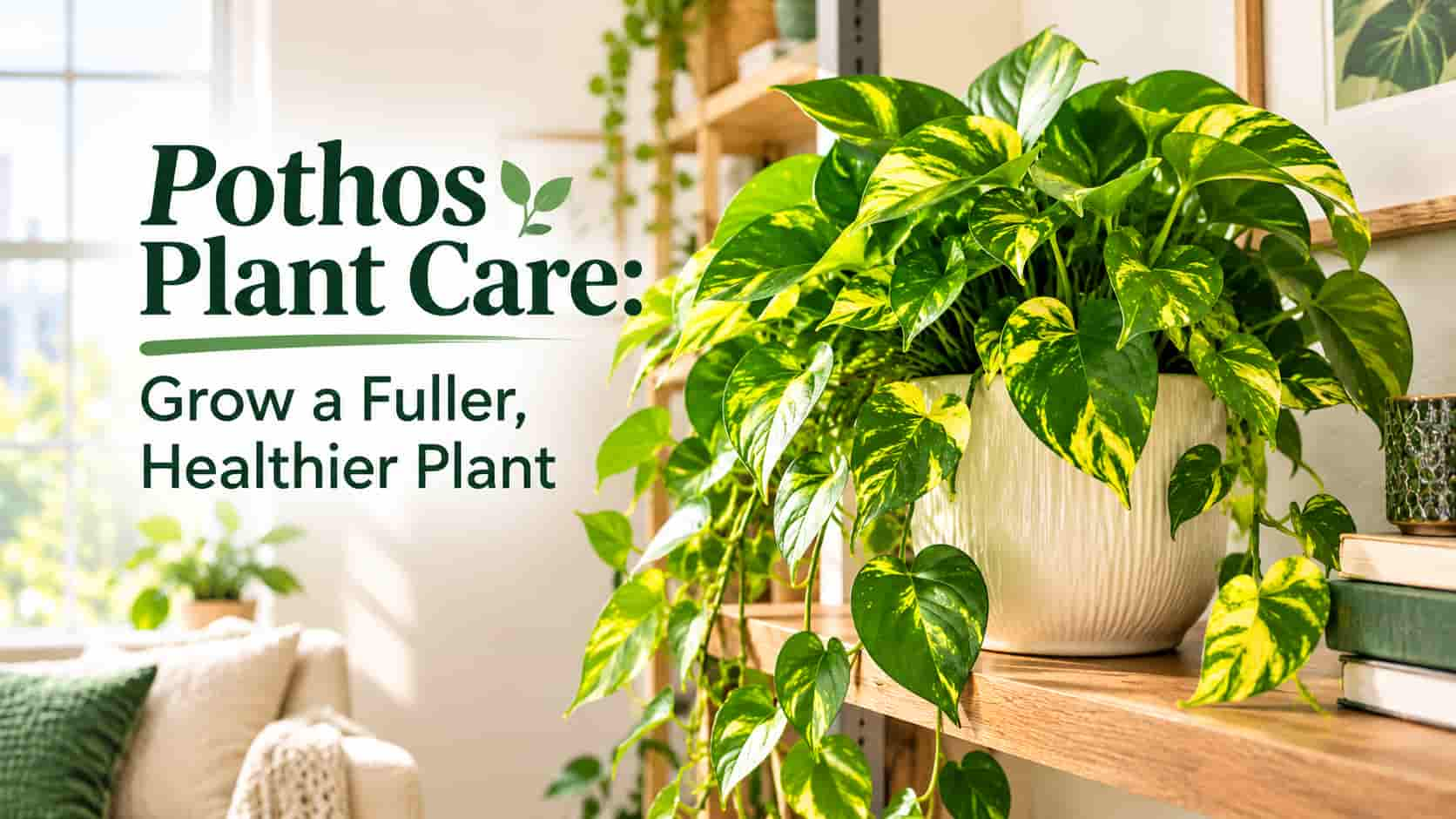
A pothos plant can transform an ordinary apartment into a refreshing green space. Its heart-shaped leaves and cascading vines look beautiful on bookshelves, hanging baskets, office desks, and windowsills.
One reason pothos is so popular is that it tolerates a range of indoor conditions. You do not need a large garden, expensive equipment, or years of gardening experience to grow one successfully.
However, even an easy-care plant can develop yellow leaves, drooping stems, or slow growth if its basic needs are overlooked.
The secret to successful pothos plant care is understanding a few simple things: light, watering, soil, temperature, and occasional pruning.
This guide explains how to keep pothos healthy indoors, solve common problems, and propagate new plants from cuttings.
Pothos Plant Care at a Glance
| Care requirement | Ideal conditions |
|---|---|
| Botanical name | Epipremnum aureum |
| Light | Bright, indirect light |
| Watering | When the top 1–2 inches of soil feel dry |
| Soil | Loose, well-draining potting mix |
| Temperature | Approximately 65–85°F |
| Humidity | Average indoor humidity is generally suitable |
| Fertilizer | Balanced houseplant fertilizer during active growth |
| Pruning | As needed to manage vines and encourage branching |
| Propagation | Stem cuttings containing a node |
| Pet safety | Toxic if chewed or ingested |
Quick answer: Pothos plant care involves placing your plant in bright, indirect light, watering when the top 1–2 inches of soil dry out, and using a well-draining potting mix. Maintain warm indoor temperatures, remove unhealthy leaves, and prune long vines to keep your plant attractive and manageable.
1. Understanding the Pothos Plant
Pothos is a tropical evergreen vine in the arum family, Araceae. It is native to the South Pacific region and is commonly grown as an ornamental houseplant.
Its trailing growth makes it particularly useful for apartments, offices, and other small spaces.
Unlike many plants that require frequent attention, pothos can tolerate occasional variations in indoor conditions. Nevertheless, consistent care produces better-looking foliage and healthier roots.
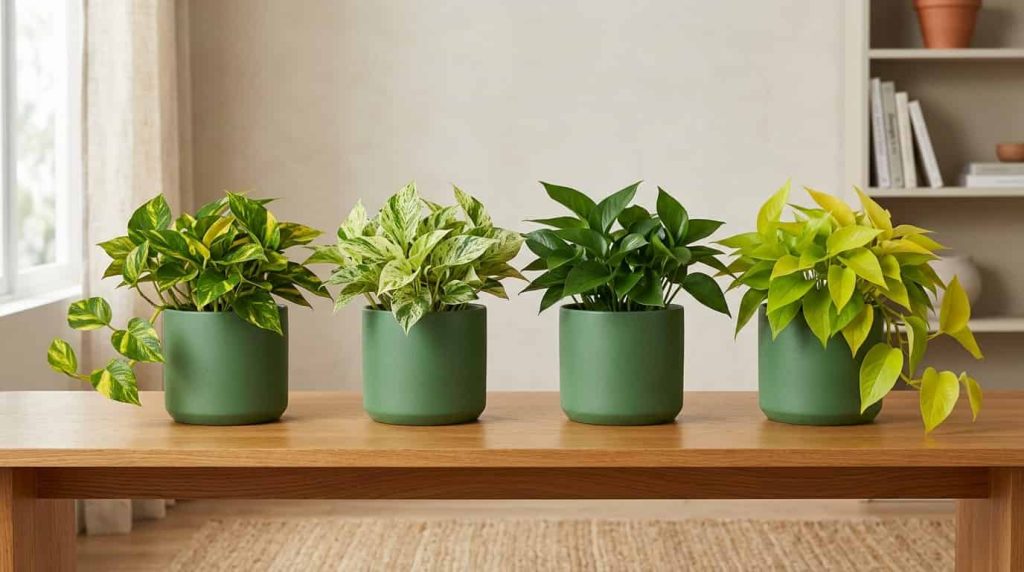
Popular pothos varieties
Golden pothos: Recognizable by its green leaves with golden-yellow variegation. It is a classic choice for beginners.
Marble Queen pothos: Features attractive cream and green marbled leaves. Brighter indirect light helps preserve its variegation.
Jade pothos: Produces mostly solid green leaves and works well in simple, minimalist interiors.
Neon pothos: Has vivid lime-green foliage that adds a bright accent to indoor plant displays.
Each variety has slightly different light preferences, but the same basic care principles apply to all of them.
2. How Much Light Does Pothos Need?
Light is one of the most important factors in successful pothos plant care.
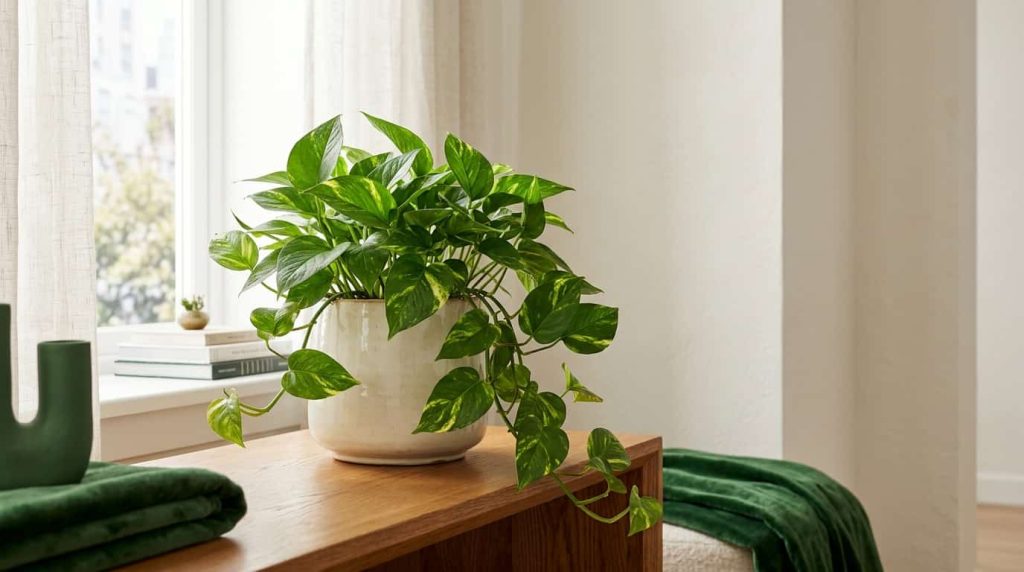
Pothos grows well in bright, indirect light. This means the plant receives plenty of natural brightness without prolonged exposure to harsh direct sunlight.
A location near a bright window is often ideal.
Best lighting conditions
-
Bright, indirect light: Encourages healthy growth and attractive foliage.
-
Medium light: Usually supports steady, although sometimes slower, growth.
-
Low light: Pothos may survive, but growth can become sparse.
-
Strong direct sunlight: May scorch leaves, particularly during hot afternoon hours.
An east-facing window can provide gentle morning sunlight. South- and west-facing windows may also work when the plant is positioned away from intense direct rays.
North-facing windows can be suitable in bright rooms, although conditions vary by season and surroundings.
Signs your pothos needs more light
Watch for these changes:
-
New leaves are smaller than previous leaves.
-
Vines become long and widely spaced.
-
Variegated leaves gradually become greener.
-
Growth slows during the growing season.
Move the plant closer to a suitable light source gradually. Avoid moving a plant from a dim corner straight into strong sunshine.
What if your apartment has little natural light?
An LED grow light can help support pothos growth in darker rooms.
Follow the manufacturer’s instructions for distance and lighting duration. Observe how the leaves respond and adjust if necessary.
3. How Often Should You Water Pothos?
Overwatering is one of the most common problems affecting indoor pothos plants.
Roots need moisture, but they also need oxygen. When the potting mix remains saturated for too long, roots can become damaged and begin to rot.
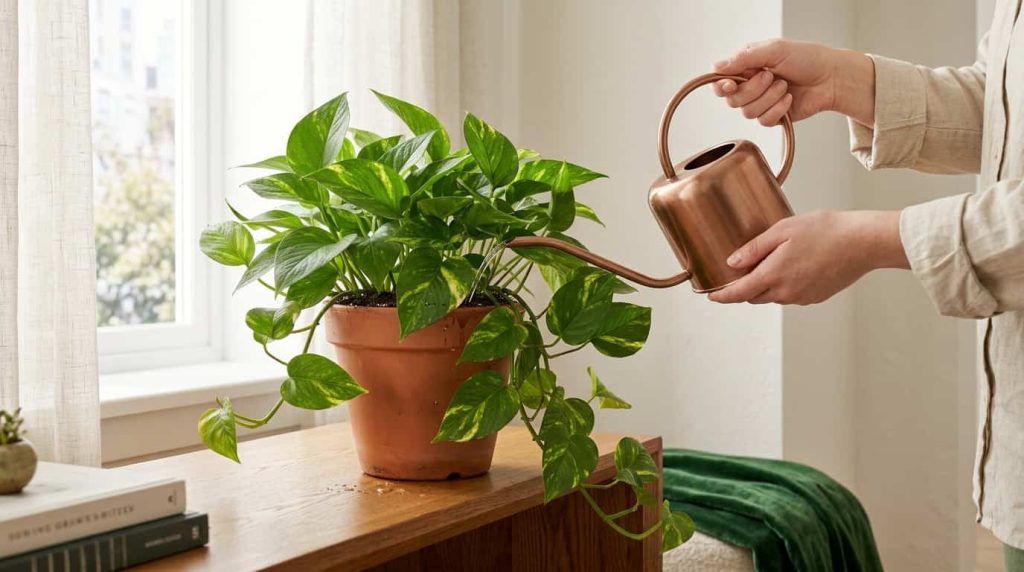
The best approach is to check the soil rather than follow a rigid watering schedule.
Step-by-step watering instructions
Step 1: Check the soil.
Insert your finger approximately 1–2 inches into the potting mix. If the soil still feels damp, wait before watering.
Step 2: Water thoroughly.
When the upper layer feels dry, pour water evenly over the soil until excess water drains from the bottom.
Step 3: Empty the saucer.
Remove standing water after the pot has drained. Never allow the roots to sit continuously in collected water.
Step 4: Check again before the next watering.
Wait until the appropriate portion of the soil dries before watering again.
How frequently should you water?
Many indoor pothos plants need watering roughly every one to two weeks, but this is only a starting estimate.
| Growing condition | Expected effect |
|---|---|
| Bright light and warm temperatures | Soil may dry faster |
| Cool indoor conditions | Soil may dry more slowly |
| Small terracotta pot | Often dries relatively quickly |
| Large plastic pot | May retain moisture longer |
| Dense or poorly draining soil | Can remain wet too long |
The potting mix, room temperature, plant size, and season all affect watering needs.
Should you mist pothos leaves?
Regular misting is not necessary. It provides only a temporary increase in humidity and does not replace proper watering.
If your indoor air is consistently dry, a humidifier is a more reliable option.
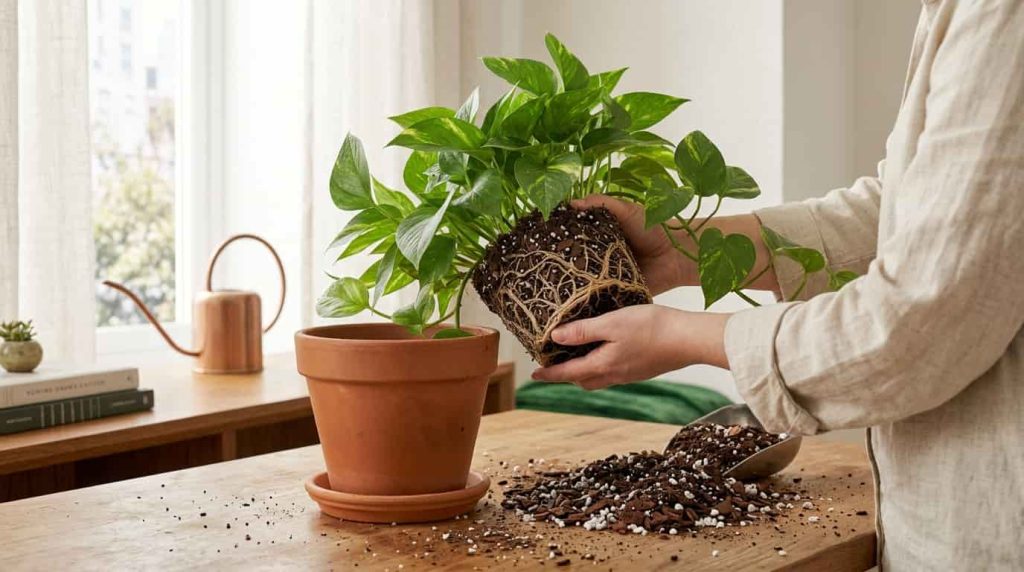
4. Choosing the Best Soil and Pot
Healthy pothos roots need a potting mix that holds some moisture without becoming waterlogged.
A quality indoor potting mix amended with aerating materials is often a practical choice.
A simple DIY pothos soil recipe
Start with:
-
2 parts indoor potting mix.
-
1 part perlite.
-
1 part orchid bark or another suitable coarse aeration material.
Mix the ingredients evenly. The goal is to create a medium that drains freely while retaining enough moisture for the roots.
Avoid heavy garden soil in indoor containers because it may compact and restrict airflow.
Which pot is best?
Choose a pot with drainage holes. Without adequate drainage, excess water can collect around the roots.
Terracotta pots allow moisture to evaporate through their porous walls. They can be useful for growers who tend to overwater.
Plastic pots retain moisture longer and may suit plants that dry out quickly.
Choose a container that fits the root ball rather than one that is dramatically larger.
When should you repot pothos?
Repot when roots become densely crowded, the soil structure deteriorates, or the plant repeatedly dries out unusually quickly.
Spring and early summer are often convenient times because growth is active. Serious root problems, however, should be addressed whenever they occur.
5. Ideal Temperature and Humidity
Pothos is a tropical plant that generally prefers warm, stable indoor conditions.
A temperature range of approximately 65–85°F is a useful target for indoor growth.
Avoid placing your plant near cold drafts, freezing windows, or heating and air-conditioning vents that create abrupt temperature changes.
How much humidity is necessary?
Average household humidity is usually sufficient for pothos.
Higher humidity may support comfortable growth, but you do not need to create a tropical greenhouse inside your apartment.
For better results:
-
Keep the plant away from direct heating airflow.
-
Avoid cold winter drafts.
-
Use a humidifier if indoor air is persistently very dry.
-
Allow sufficient airflow around dense foliage.
Consistent watering and adequate light generally matter more than chasing a precise humidity percentage.
6. Fertilizing Pothos for Healthy Growth
Pothos does not need heavy feeding to remain healthy.
During spring and summer, a balanced liquid houseplant fertilizer can support active growth. Follow the product instructions and avoid applying concentrated fertilizer to dry or stressed roots.
A simple fertilizing routine
-
Choose a balanced fertilizer suitable for indoor foliage plants.
-
Follow the recommended dilution on the label.
-
Fertilize during active growth when appropriate.
-
Reduce feeding when growth slows during winter.
-
Watch for fertilizer buildup or recurring brown leaf tips.
Too much fertilizer can damage roots and contribute to mineral accumulation in the potting mix.
Remember that fertilizer cannot compensate for poor lighting, overwatering, or unhealthy roots.
7. How to Prune Pothos for Fuller Vines
Pothos naturally produces trailing stems. Over time, some vines can become long, uneven, or sparse.
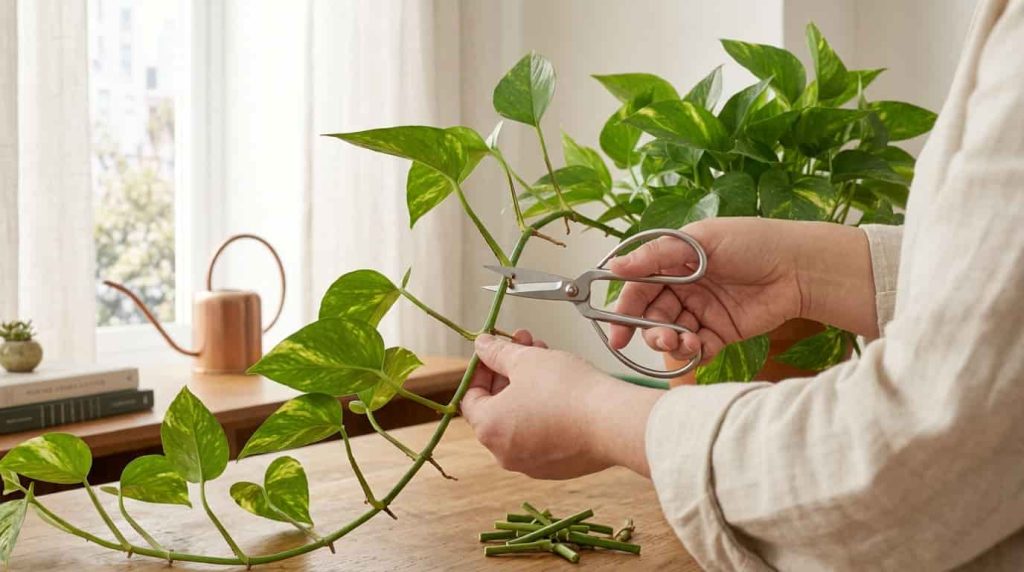
Pruning helps control the plant’s shape and provides healthy cuttings for propagation.
Step-by-step pruning guide
-
Clean your pruning scissors before cutting.
-
Identify a healthy stem and locate a node, where a leaf or aerial root emerges.
-
Cut just above a node on the parent plant when shortening a vine.
-
Remove dead or badly damaged leaves.
-
Save suitable healthy stem cuttings if you want to grow additional plants.
Pruning can encourage branching, but it does not guarantee that every bare section will produce new leaves.
How to make pothos bushier
For a fuller-looking plant, combine adequate indirect light with strategic pruning.
You can root several stem cuttings and plant them back into the same pot after they develop healthy roots. Multiple stems create a denser appearance than a single long vine.
Rotate the pot occasionally to help the plant receive more even light.
8. How to Propagate Pothos
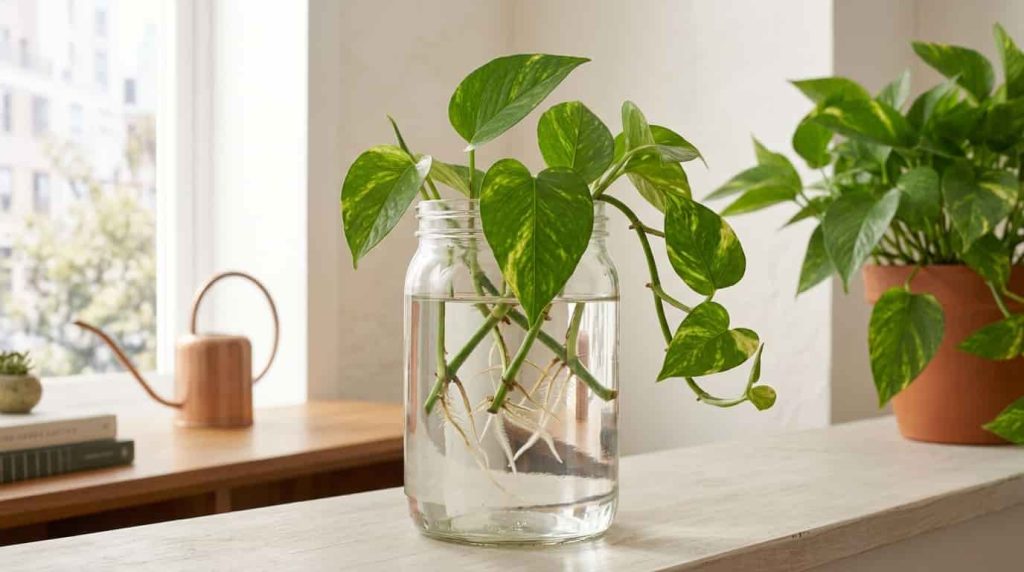
Pothos is easy to propagate using stem cuttings that contain at least one viable node.
A leaf alone, without a node, will not normally develop into a complete new vine.
Method 1: Water propagation
-
Select a healthy vine and cut a section containing one or more nodes.
-
Remove leaves that would sit underwater.
-
Place the cutting in a clean jar of water with at least one node submerged.
-
Keep the jar in bright, indirect light.
-
Refresh the water regularly and monitor root development.
-
Transfer the cutting into potting mix when the roots are sufficiently developed.
Method 2: Soil propagation
-
Prepare a small pot with a loose propagation mix.
-
Take a healthy stem cutting containing a node.
-
Place the node into the moist growing medium.
-
Keep the medium lightly moist without saturating it.
-
Provide bright, indirect light while the cutting develops roots.
Avoid repeatedly pulling out the cutting to check for root growth.
Water versus soil propagation
| Feature | Water | Soil |
|---|---|---|
| Root visibility | Easy to observe | Roots remain hidden |
| Equipment | Clean jar and water | Small pot and growing mix |
| Moisture care | Refresh water regularly | Keep medium lightly moist |
| Transfer required | Yes, for soil growing | No, if staying in soil |
| Best for | Beginners who want visible roots | Growers who prefer fewer transitions |
9. Common Pothos Problems and Solutions
Even an easy-care plant can develop problems when its growing conditions are unsuitable.
The most effective solution is to identify the likely cause before changing your routine.
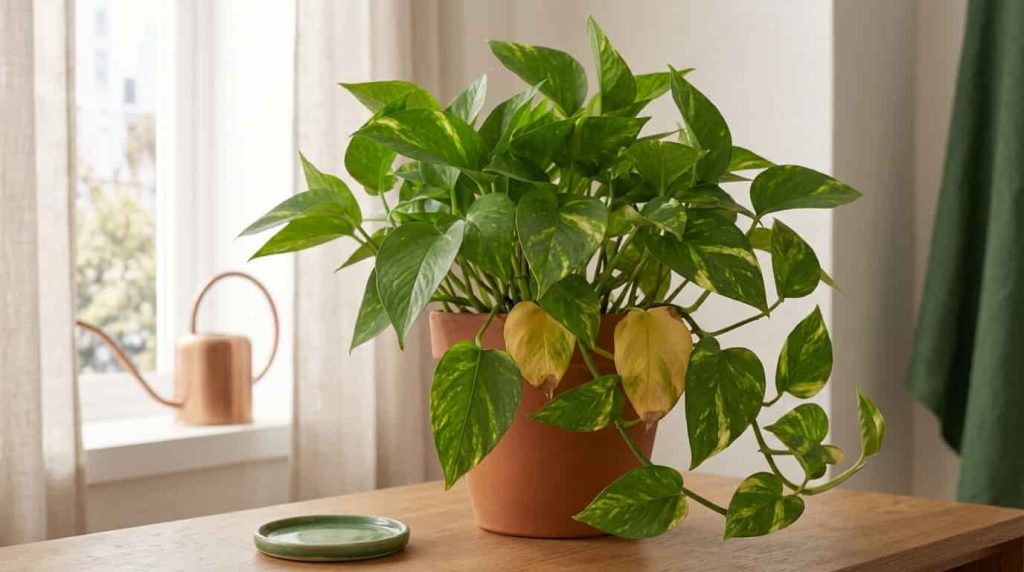
Why are pothos leaves turning yellow?
Yellow leaves can result from overwatering, poor drainage, insufficient light, or normal aging of older foliage.
Check whether the soil remains wet for extended periods. If it does, inspect the drainage holes and consider whether the potting mix is too dense.
If the soil is dry, review your watering routine instead of assuming that the plant needs less water.
Why are pothos leaves turning brown?
Brown tips and edges may develop because of inconsistent watering, fertilizer buildup, mineral-rich water, or very dry indoor conditions.
Check the soil moisture and review fertilizer use. Trim damaged edges with clean scissors if desired.
Brown tissue will not become green again, but healthy new growth can improve the plant’s appearance.
Why is my pothos drooping?
Drooping can indicate dry soil or damaged roots from excessive moisture.
-
If the soil is dry, water thoroughly.
-
If the soil is wet, check drainage and root health.
-
If the plant was recently moved, consider temperature or light stress.
Always check soil moisture before deciding what to do.
Why is my pothos growing slowly?
Insufficient light, cool temperatures, root problems, and seasonal changes can all slow growth.
Start by checking the plant’s location and soil condition. Avoid adding extra fertilizer until you have ruled out the more common causes.
Troubleshooting table
| Symptom | Possible cause | Recommended action |
|---|---|---|
| Yellow leaves | Overwatering or aging foliage | Check soil and inspect the overall plant |
| Brown tips | Watering inconsistency or mineral buildup | Review watering and fertilizer |
| Drooping leaves | Dry soil or damaged roots | Check moisture before watering |
| Long, sparse vines | Low light or limited branching | Improve light and prune strategically |
| Slow growth | Seasonal slowdown or poor conditions | Check light, temperature, and roots |
| Soft, dark roots | Possible root rot | Remove damaged roots and correct drainage |
| Loss of variegation | Often insufficient light | Gradually improve indirect light |
10. Seasonal Pothos Plant Care
Indoor growing conditions change throughout the year. Adjust your routine according to how quickly the soil dries and how actively your plant is growing.
Spring
-
Check whether the plant needs repotting.
-
Begin or resume appropriate fertilization as growth increases.
-
Prune long vines.
-
Propagate healthy cuttings.
Summer
-
Check soil moisture more frequently during hot weather.
-
Protect leaves from intense direct sunlight.
-
Inspect foliage for pests.
-
Maintain good airflow.
Fall
-
Reduce fertilizer as growth slows.
-
Inspect new plants for pests before placing them near existing plants.
-
Adjust watering as indoor light levels change.
Winter
-
Water less frequently when soil dries more slowly.
-
Keep the plant away from cold drafts.
-
Avoid unnecessary repotting if the plant is healthy and growing slowly.
-
Consider supplemental lighting if natural light is limited.
The goal is to respond to actual conditions rather than follow a fixed seasonal schedule.
11. Can Pothos Grow in Water Permanently?
Yes. Pothos can grow in water for extended periods when its roots receive suitable conditions and nutrients.
Place a healthy stem cutting in a clean container, keeping a node underwater and the leaves above the waterline.
Refresh the water regularly, clean the container when necessary, and monitor the roots for deterioration.
For long-term growth, the plant needs suitable mineral nutrients. Plain water alone generally does not supply everything required indefinitely, so an appropriate hydroponic nutrient solution may be necessary.
Water-grown pothos can look attractive on desks, shelves, and windowsills, especially when you want to observe root development.
12. Is Pothos Toxic to Pets?
Yes. Pothos is toxic if chewed or ingested because it contains insoluble calcium oxalate crystals.
These crystals can cause oral irritation, pain, and swelling.
Keep pothos away from cats, dogs, and young children. Hanging baskets can reduce access, but make sure trailing vines cannot easily be reached or pulled down.
If a pet chews the plant, contact a veterinarian for advice. If a person ingests pothos or experiences significant swelling or difficulty swallowing, seek medical or poison-control guidance. Breathing difficulty requires emergency assistance.
13. Small-Apartment Pothos Care Tips
Pothos is especially useful for people who want greenery without sacrificing valuable floor space.
Use vertical space
Place the plant on a stable shelf or in a securely installed hanging planter. Keep trailing vines away from pets and walkways.
Create a simple plant-care station
Keep your watering can, clean pruning scissors, and other basic supplies together. This makes regular maintenance easier.
Train vines upward
A suitable support can help organize long stems and create a vertical display.
Avoid overcrowding
Allow air to circulate around dense foliage, and remove dead leaves as needed.
Weekly maintenance checklist
Fertilizing and repotting are occasional tasks, not weekly requirements.
Frequently Asked Questions
1. How often should I water my pothos indoors?
Water when the top 1–2 inches of soil feel dry. Many indoor plants need watering approximately every one to two weeks, but your conditions may differ. Always check the soil before watering.
2. Can pothos grow without sunlight?
Pothos can tolerate low-light conditions, but it still requires light to grow. A room without natural light may need an LED grow light to support healthy foliage.
3. How do I make pothos grow faster and fuller?
Provide bright, indirect light, use well-draining soil, and water according to soil moisture. Prune long vines and plant rooted cuttings back into the same container for a fuller appearance.
4. Why is my pothos dying even though I water it regularly?
Frequent watering may keep the soil too wet and damage the roots. Check drainage and soil moisture first. Other possible causes include insufficient light, cold drafts, pests, and fertilizer buildup.
External Authority Resources
For additional information, link naturally to these reputable resources:
-
North Carolina State University Extension: Pothos — plant identification and growing information.
-
University of Minnesota Extension: Houseplants — general indoor plant care guidance.
-
ASPCA Animal Poison Control — pet toxicity resources.
Verify the relevant page details before publishing.
Read: 15 Best Low Light Indoor Plants for Apartments
Final Thoughts
Successful pothos plant care does not have to be complicated. Provide suitable indirect light, water according to soil moisture, use a well-draining potting mix, and prune when necessary.
With a little attention, pothos can produce attractive trailing vines that bring greenery to almost any indoor space.
Whether you keep your plant on a bookshelf, grow it in a hanging basket, or propagate new cuttings in a glass jar, consistency matters more than a complicated routine.
2 thoughts on “Pothos Plant Care: Complete Indoor Growing Guide”