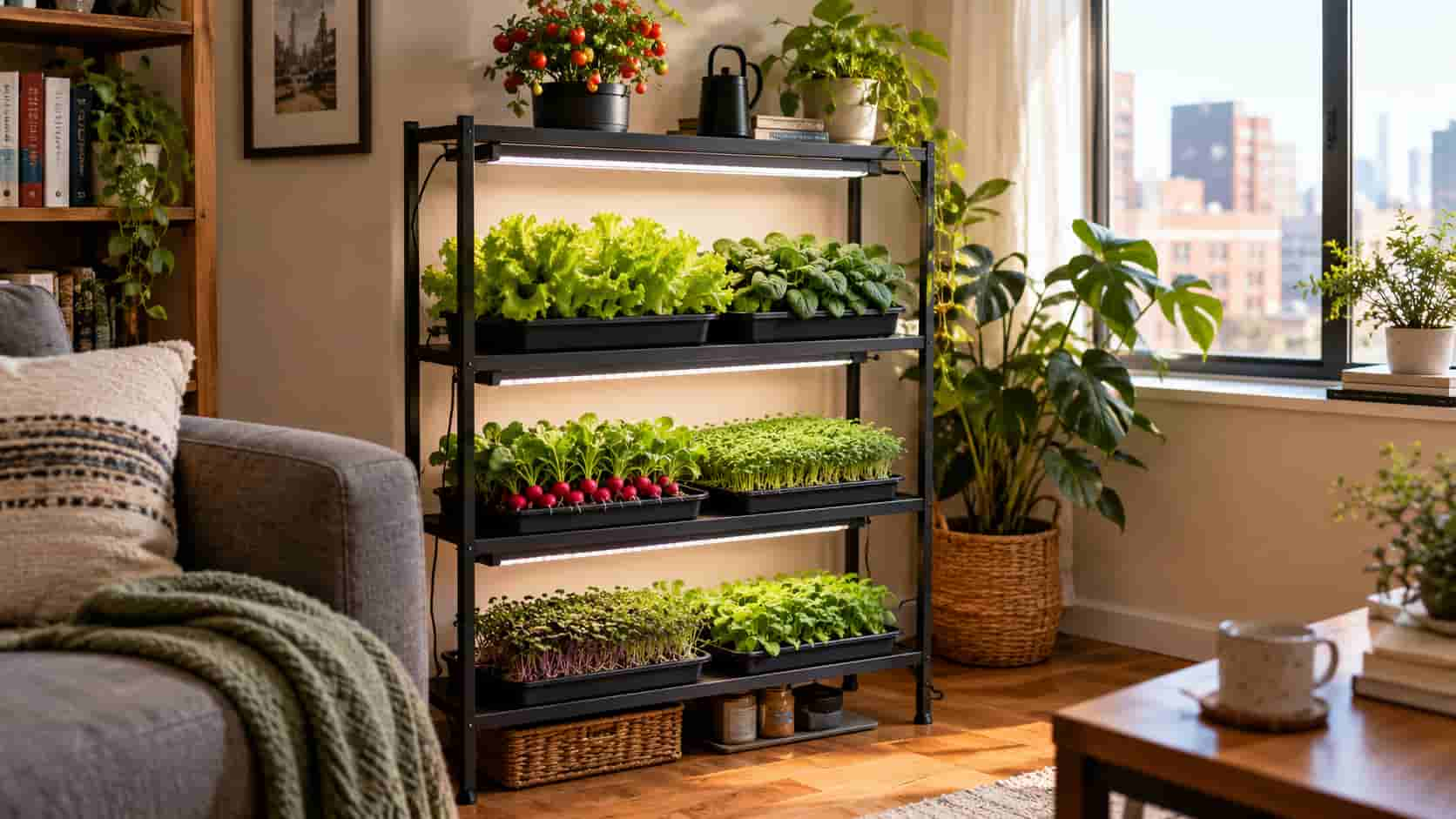
I’ve killed more basil plants than I’ll ever admit, and I still found a way to grow real salads in a 600-square-foot rental with zero outdoor space. These indoor vegetable garden ideas for apartments without balcony access work because they stop fighting your living room and start using it.
Here’s the short version before we get into the weeds.
- Light is the whole game. A cheap full spectrum LED grow light beats a “bright” window nearly every time, especially in winter.
- Start with leafy greens, radishes, and microgreens. They forgive mistakes and pay you back in two to six weeks.
- Vertical wins. Tiered shelving units and wall-mounted planters give you more growing area without eating floor space.
- Drainage and airflow prevent most disasters. Skip either one and you’ll meet fungus gnats fast.
Why a Balcony Isn’t Required (and Why I Stopped Missing Mine)
Look, a balcony helps. Free sun is free sun. But a balcony also brings wind, pigeons, landlord rules, and a growing season that shuts down in October.
An indoor setup runs on your schedule. You control the light, the temperature, the water, and the bugs (mostly). That’s not a consolation prize. It’s honestly a more predictable way to grow food.
The catch? You have to supply what the sky usually does. That means deliberate lighting, decent airflow, and a little planning. Nothing scary.
Start With Light: The Part Most Beginners Get Wrong
Most apartment windows lie to you. A room that feels bright to your eyes is often a fraction of what a tomato or even a lettuce head wants. A south-facing window can work for leafy greens, but a north-facing one? Forget it.
Grow Lights: LED vs. Everything Else
For almost every indoor vegetable garden idea for apartments without balcony space, I recommend full spectrum LED grow lights. They run cool, sip electricity, and last for years. Old-school fluorescent tubes still work for greens, but they’re bulkier and fade faster.
What to look for:
- Full spectrum (white-looking light), not the purple-pink “blurple” kind. White light is easier on your eyes, and you can actually see if your plants look healthy.
- A built-in timer or a cheap outlet timer. You’ll forget otherwise. I did, for a week, and my spinach sulked.
- Adjustable height. Lights need to move up as plants grow.
Supplemental Lighting and Photoperiod
Photoperiod just means how many hours of light your plants get per day. Leafy greens do well with roughly 12 to 16 hours under LEDs. Fruiting crops like cherry tomatoes want about 14 to 16 hours plus stronger light.
Every plant needs a dark period too. Don’t run lights 24/7. Plants need that rest.
If your window gives you a few good hours, treat the LED as supplemental lighting and fill in the gaps. If your apartment is a cave, the LED does all the work. Either way, a plain mechanical timer is the best ten dollars you’ll spend.
How Close Should the Light Be?
Closer than you think. For most compact LED panels, 6 to 12 inches above leafy greens is a good starting range, but check the manufacturer’s guidance for your specific light. Pale, stretchy seedlings mean the light is too far away. Crispy leaf edges mean it’s too close.
Indoor Vegetable Garden Ideas for Apartments Without Balcony: The 9 Setups I’d Build First
Here’s where it gets fun.
1. The Window Sill Garden
The classic. A window sill garden works best for herbs, microgreens, and small lettuces. Use narrow trays that fit your sill and rotate them every few days so nothing leans toward the glass.
One warning: windows get cold at night in winter. Leaves touching cold glass can get damaged. Pull your trays back a few inches after dark if you live somewhere chilly.
2. Tiered Shelving Units With Clip-On Lights
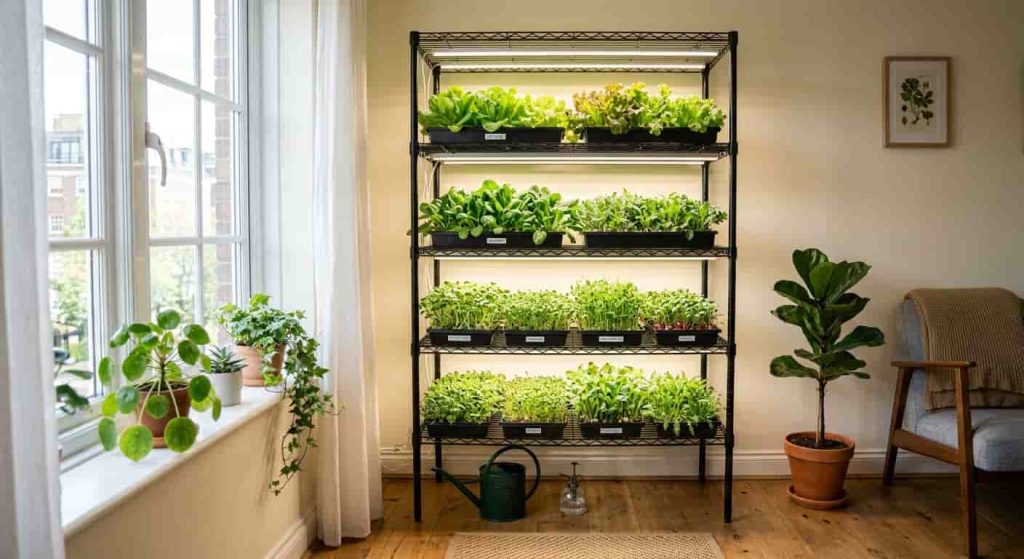
This is my favorite of all the indoor vegetable garden ideas for apartments without balcony access, and it’s the one I’d tell any beginner to build first. A metal wire rack with three or four shelves, a light strip under each, and trays of greens on top. You can fit it into a closet corner, beside a couch, or next to a bookshelf.
Each shelf becomes its own mini garden. You can stagger plantings so something’s always ready to cut.
Quick tip: put a plastic tray or old baking sheet under every pot. Drips happen, and your security deposit will thank you.
3. Vertical Planters and Wall-Mounted Planters
If floor space is gone, go up the wall. Wall-mounted planters and pocket-style vertical planters hold herbs, lettuces, and small greens. They look great, too (which matters when you live in the space you’re growing in).
Watch the weight. A wet planter full of soil is heavy, and drywall isn’t magic. Use proper anchors, and keep it light with a quality potting mix rather than dense garden soil.
Also, water runs downhill. The bottom pocket gets soaked while the top one dries out. Plant thirstier crops low and tougher ones high.
4. Self-Watering Pots for the Forgetful (That’s Me)
Self-watering pots have a reservoir at the bottom that wicks moisture up to the roots. They’re great for busy people, travelers, and anyone who swings between drowning and neglecting their plants.
They’re especially good for lettuce, which hates drying out completely. Still check the reservoir weekly, and don’t let it sit stagnant for weeks.
5. Hydroponic Systems and Aeroponics
Okay, this one sounds fancy, but countertop hydroponic systems are honestly the easiest route to fast greens. Roots sit in nutrient-rich water (or are misted, in the case of aeroponics), and the built-in light does the rest.
Pros:
- Fast growth, often noticeably quicker than soil
- No soil mess or soil-borne pests
- Compact and tidy
Cons:
- Upfront cost
- You’ll need to refill water and add nutrients
- Fruiting crops like tomatoes are harder in small units
If you want a no-fuss start, buy a small countertop unit and grow lettuce and herbs. Upgrade later if you catch the bug.
6. Microgreens: The Fastest Win You’ll Ever Get
Microgreens are tiny, nutrient-packed seedlings harvested in about 7 to 14 days. Radish, pea shoots, broccoli, and sunflower are all popular. You need a shallow tray, a thin layer of potting mix, seeds, and light.
Seven days. That’s it. You’ll be eating something you grew before you’ve lost interest.
They need very little root depth, so a tray two inches deep is plenty. They’re a brilliant confidence booster.
7. A Leafy Greens Station
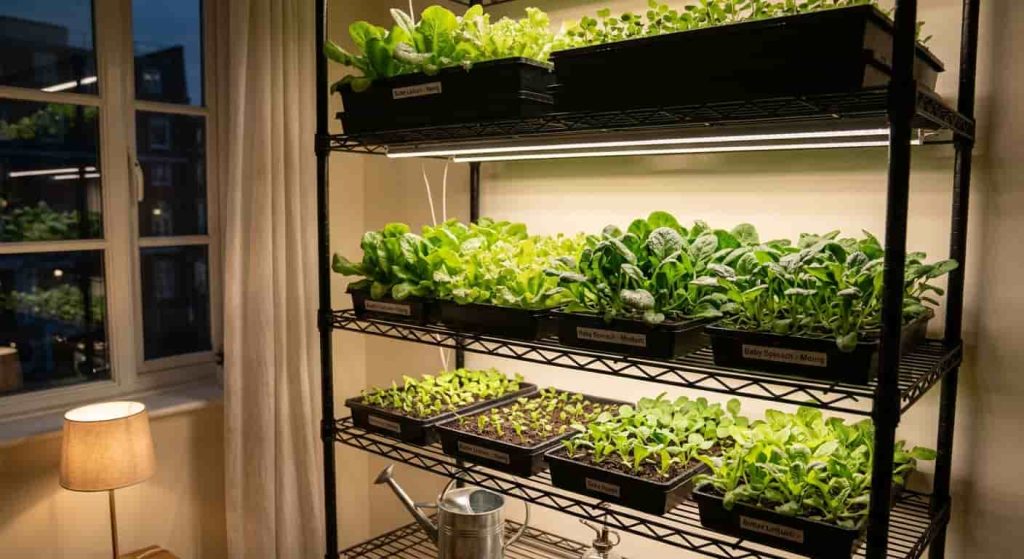
Lettuce and spinach are the backbone of any apartment garden. Cut-and-come-again varieties let you harvest outer leaves while the center keeps producing. That means one plant feeds you for weeks.
Lettuce is relaxed about light compared to tomatoes. Spinach prefers cooler temperatures, so keep it away from heaters.
8. Radishes in Deep Trays
Radishes are weirdly satisfying. Plant them, wait three to four weeks, pull a pink globe out of the dirt. Done.
They need a vessel about 6 inches deep so the roots have room to swell. Crowd them and you get leaves but no radishes, so thin your seedlings without guilt.
9. Cherry Tomatoes: The Ambitious One
Can you grow cherry tomatoes without a balcony? Yes. Should you start with them? Honestly, no.
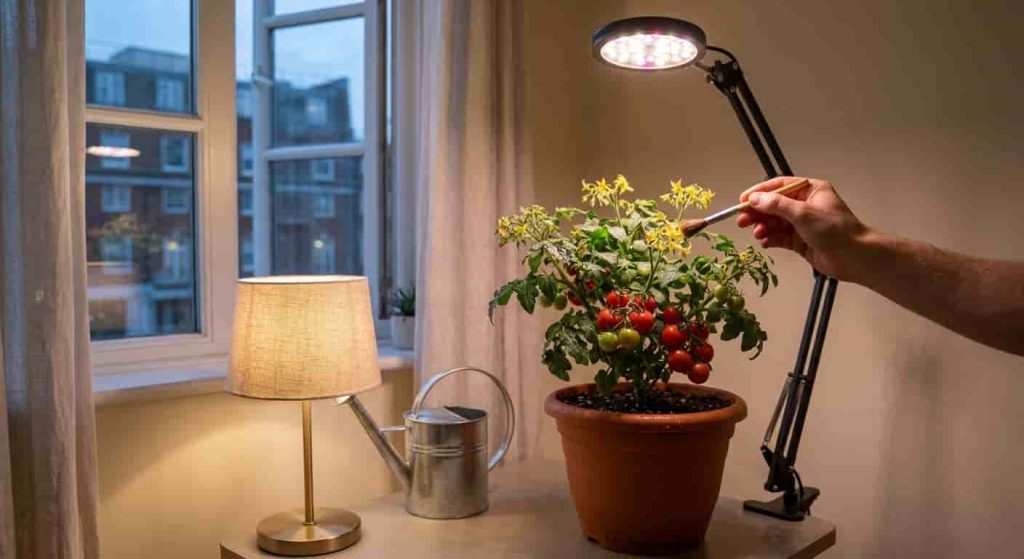
Pick a compact or dwarf variety bred for containers. Give it a pot of at least a few gallons, strong light, and good airflow. Indoors there are no bees, so you’ll need to pollinate by hand. Gently shake the flower clusters or tap them with a soft brush once the blooms open.
You’ll get fewer tomatoes than an outdoor plant. But a bowl of homegrown cherry tomatoes in February? Worth it.
Soil, Containers, and Drainage: The Boring Stuff That Saves Your Plants
Potting Mix and Organic Soil Blend
Never use soil from outside. It compacts, brings pests, and drains poorly in pots. Buy a quality potting mix, ideally an organic soil blend with perlite or coco coir for airflow.
If the bag feels heavy and muddy, put it back. Good mix feels light and fluffy.
Container Drainage and Drainage Holes
Drainage holes are non-negotiable. A pot without them turns into a swamp, and roots rot fast. If you love a decorative pot with no holes, use it as a cover and keep your plant in a cheaper nursery pot inside.
Always use a saucer. Empty it after watering, because roots sitting in standing water get unhappy quickly.
Root Depth and Vessel Size
Match the vessel to the vegetable. Here’s my rough cheat sheet:
- Microgreens: about 1 to 2 inches deep
- Lettuce and spinach: about 6 inches deep
- Radishes: about 6 inches deep
- Dwarf cherry tomatoes: several gallons of soil volume
Too small a pot stunts everything. Too big a pot holds extra water that the roots can’t use. Go for a snug fit.
Water, Humidity, and Air Circulation
Indoor air is usually drier than plants like, especially in winter with the heat on. Aim for moderate humidity levels, somewhere around 40 to 60 percent, which a cheap hygrometer will tell you.
Airflow matters just as much. Stagnant, damp air invites mildew and pests. A small clip-on fan on low, running a few hours a day, strengthens stems and keeps things fresh. Don’t blast your plants. A gentle breeze is plenty.
Water when the top inch of soil feels dry, not by calendar. Stick your finger in. It’s the most reliable tool you own.
Feeding Your Indoor Vegetables
Potting mix runs out of nutrients. Indoors, there’s no rain to wash fresh minerals in, so you’ll need to feed.
Liquid organic fertilizers are easy and gentle. Dilute them to half the label strength at first and feed every couple of weeks during active growth. More isn’t better. Over-fertilizing burns roots and leaves a white crust on the soil.
Microgreens don’t need feeding at all, since the seed has everything for that short life.
Indoor Pest Management: Fungus Gnats and Friends
Let’s talk about the tiny black flies hovering over your pots. Fungus gnats. Everyone gets them eventually.
They breed in constantly wet soil. So the fix starts with watering less, letting the top inch dry out between drinks.
What helps:
- Yellow sticky traps to catch adults
- Letting the surface dry out between waterings
- A top dressing of coarse sand or fine gravel
- A soil drench with a biological product containing BTI, which targets larvae
For other pests like aphids or spider mites, neem oil is a gentle first line of defense. Dilute it according to the label, test on one leaf first, and avoid spraying under strong lights, which can scorch wet leaves. Spray in the evening and keep new plants quarantined for a week or two.
Mistakes I Made So You Don’t Have To
- Buying a pretty light with weak output. Pretty isn’t productive.
- Overwatering. Almost every dead plant I’ve owned drowned.
- Starting with tomatoes. Ego move. Start with greens.
- Skipping the timer. Inconsistent light means leggy, sad plants.
- Ignoring airflow. Mildew showed up within weeks.
A Simple Starter Plan for Your First Month
Week one: set up one shelf, one light, and a timer. Sow microgreens and a tray of lettuce.
Week two: harvest your first microgreens. Seriously, eat them. Add a pot of radishes.
Week three: thin the radishes, start feeding the lettuce lightly, and check your humidity.
Week four: you’re cutting salad leaves. If things are going well, add a dwarf cherry tomato under its own light.
Small steps. That’s how indoor vegetable garden ideas for apartments without balcony space turn into a habit instead of a pile of dead pots.
Read: Pothos Plant Care: Complete Indoor Growing Guide
Budget Reality Check
You don’t need a fortune. A basic wire shelf, one or two LED grow lights, a timer, trays, potting mix, and seeds can run you a modest amount. Hydroponic countertop units cost more up front but save time. Start cheap, learn what you actually like growing, and upgrade only when you need to.
FAQ: Indoor Vegetable Gardening Without a Balcony
Can you grow vegetables indoors without a balcony or direct sunlight?
Yes. A full spectrum LED grow light can replace sunlight entirely for leafy greens, radishes, and microgreens. Fruiting vegetables like cherry tomatoes need stronger lighting and longer photoperiods, but they’re possible too.
What are the best vegetables for a small apartment with no outdoor space?
Lettuce, spinach, radishes, and microgreens are the easiest. They grow quickly, need shallow containers, and tolerate typical indoor conditions. Dwarf cherry tomatoes are a good second-stage project once you’re comfortable.
How much light do indoor vegetables need each day?
Leafy greens generally do well with about 12 to 16 hours of LED light, while fruiting crops often want closer to 14 to 16 hours with higher intensity. Always give plants a dark period at night, and use a timer so the schedule stays consistent.
How do I stop fungus gnats in my indoor vegetable garden?
Water less often and let the top inch of soil dry between waterings. Add yellow sticky traps, use a BTI-based soil treatment for larvae, and make sure your pots have proper drainage holes. Consistently soggy soil is what fungus gnats love most.
1 thought on “Indoor Vegetable Garden Ideas for Apartments Without Balcony: 9 Setups That Actually Produce Food”