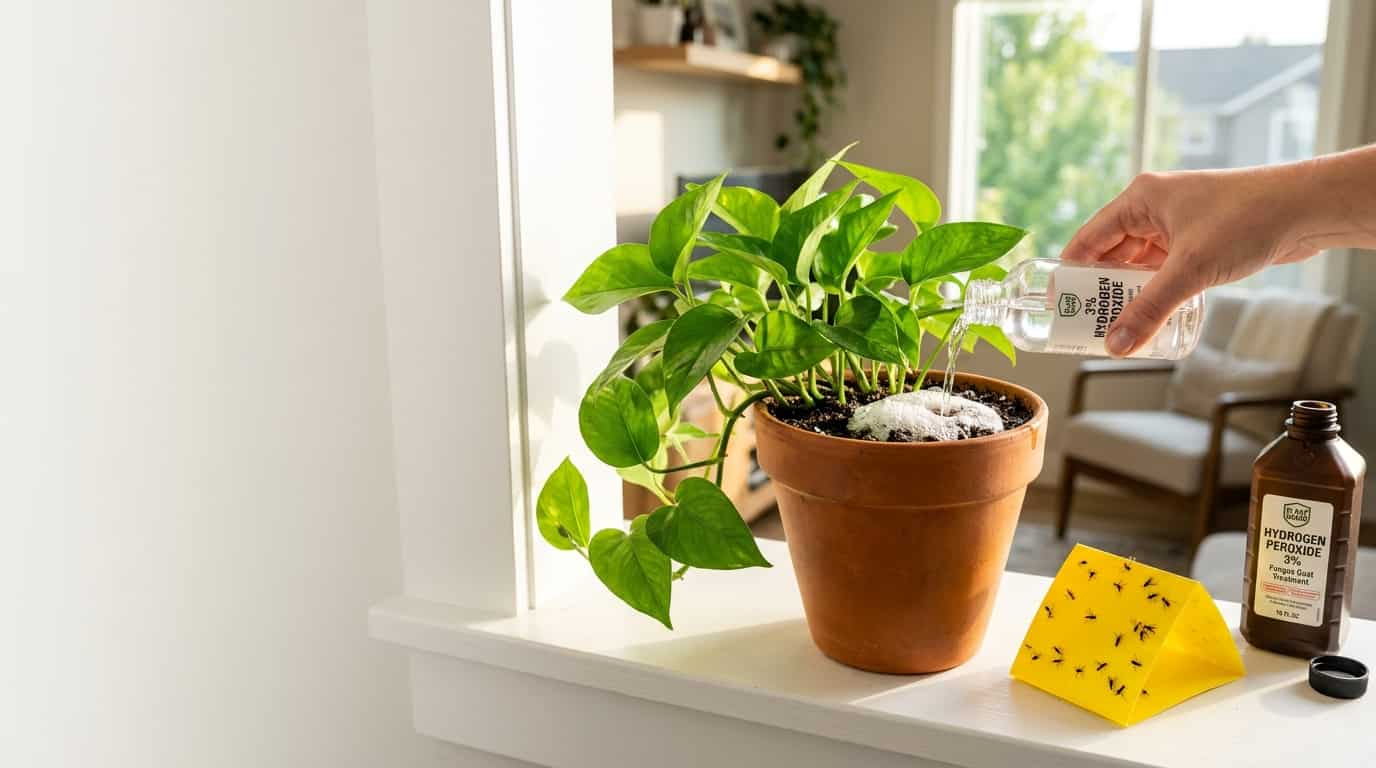
Learning how to get rid of fungus gnats with hydrogen peroxide ratio math is the fastest way to stop those tiny black flies from circling your houseplants. You pour, you wait, and the soil fizzes like a science fair volcano. But one wrong dilution, or one lazy follow-up, and the gnats are back in two weeks.
I’ve made every mistake in the book, so you don’t have to.
Quick Takeaways
- The ratio: Mix 1 part 3% hydrogen peroxide with 4 parts room-temperature water, then drench the soil.
- The target: The drench kills larvae in the top few inches of soil. Adult flies need sticky traps.
- The schedule: Repeat every 5 to 7 days for about 3 weeks to catch every life stage.
- The real fix: Let the soil dry between waterings, or the gnats will return.
Confirm You Actually Have Fungus Gnats
Before you mix anything, make sure you’re fighting the right bug. This is the number one reason people say peroxide “doesn’t work.”
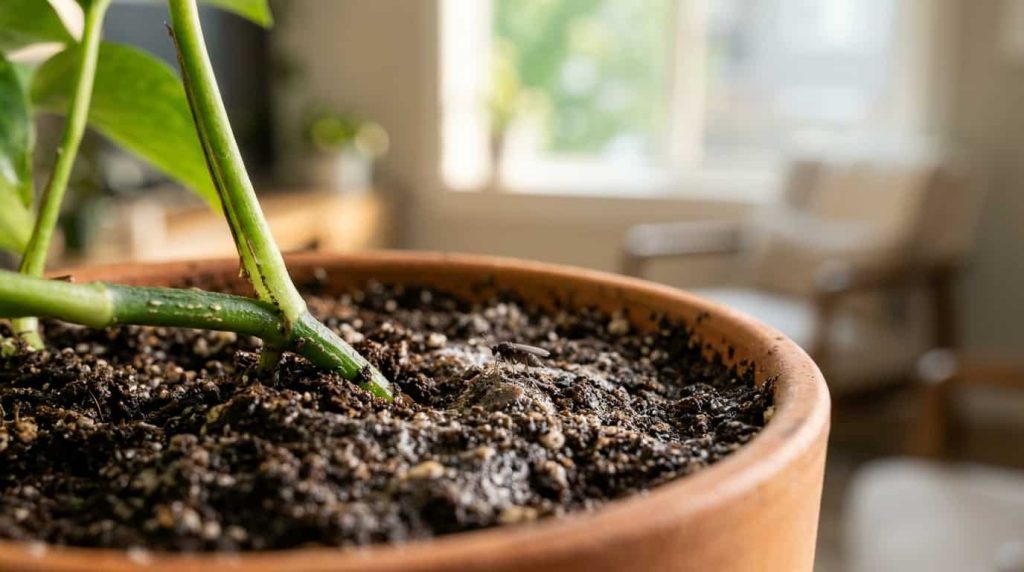
Fungus gnats are small, dark, mosquito-looking flies. They’re weak fliers and often walk across the soil surface instead of zooming around. Most fungus gnats are weak fliers and often walk over plants and soil rather than flying.
Fruit flies are different. They’re tan, chunkier, and they hang around your banana bowl, not your pothos. Peroxide in the soil does nothing to them.
Shore flies are a third lookalike. They’re stockier with shorter antennae and tend to show up in very wet, algae-covered soil.
Here’s a quick test I use. Lay a slice of raw potato on top of the soil for a day. Flip it over, and if you see tiny white wormlike larvae with black heads on the underside, you’ve got fungus gnats.
Does Hydrogen Peroxide Really Work?
Mostly, yes. But with caveats.
The reason it works is simple. Hydrogen peroxide breaks down into water and oxygen, and the fizzing you see is that reaction. The larvae thrive in damp, low-oxygen soil, and the peroxide kills them on contact.
Here’s the honest part. Peroxide only kills what it touches on the day you apply it. Eggs, pupae, and adults can sit out the first drench, which is why one treatment rarely finishes the job.
Some folks in comment sections swear it fails completely. Usually the culprit is the wrong bug, a weak mix, or soil that stays soggy afterward. Common causes of failure include fruit flies being mistaken for gnats, continued overwatering, too weak a concentration, and skipping sticky traps for the adults.
One more thing. A university extension expert answering a gardener’s question suggested trying gentler controls first, like fresh potting soil and cleaning out breeding spots. They also pointed out that fungus gnats are mostly an annoyance and recommended caution with peroxide.
That’s fair. Peroxide is a tool, not a magic wand.
(Source: [University Extension Fungus Gnat Guide])
How to Get Rid of Fungus Gnats With Hydrogen Peroxide Ratio: The Exact Mix
Here’s the ratio you came for. One part 3% hydrogen peroxide to four parts water.
That’s the mix extension guidance gives as one part 3% solution to four parts water, and it’s the same one you’ll see repeated across gardening sources. It works out to roughly a 0.6% solution once diluted.
The ratio works in any unit. Cups, quarts, a repurposed peanut butter jar, whatever. Just keep it 1 to 4.
Some growers go gentler. One nursery recommends a 1:8 mix for general soil watering until water runs out of the pot’s bottom. That’s about 0.33%, which is a smart choice for delicate plants.
Here’s a simple breakdown of your options, using the bottle you actually have:
- Standard drugstore 3% (brown bottle): Mix 1 part peroxide with 4 parts water for a normal drench.
- Gentle version for sensitive plants: Mix 1 part 3% peroxide with 8 parts water.
- 6% peroxide: Mix 1 part peroxide with 9 parts water to land at the same strength as the 1:4 mix.
- 35% “food grade”: Skip it. It burns skin and eyes, and one measuring slip can scorch roots.
Use room-temperature water, not hot. Heat speeds up peroxide breakdown before it even reaches the larvae.
Mix it fresh, right before pouring. Don’t store it, because it loses strength fast and a sealed bottle of mixed solution can build pressure.
What You Need Before You Start
Gather everything first. You don’t want to be hunting for a funnel while the peroxide fizzes away on the counter.
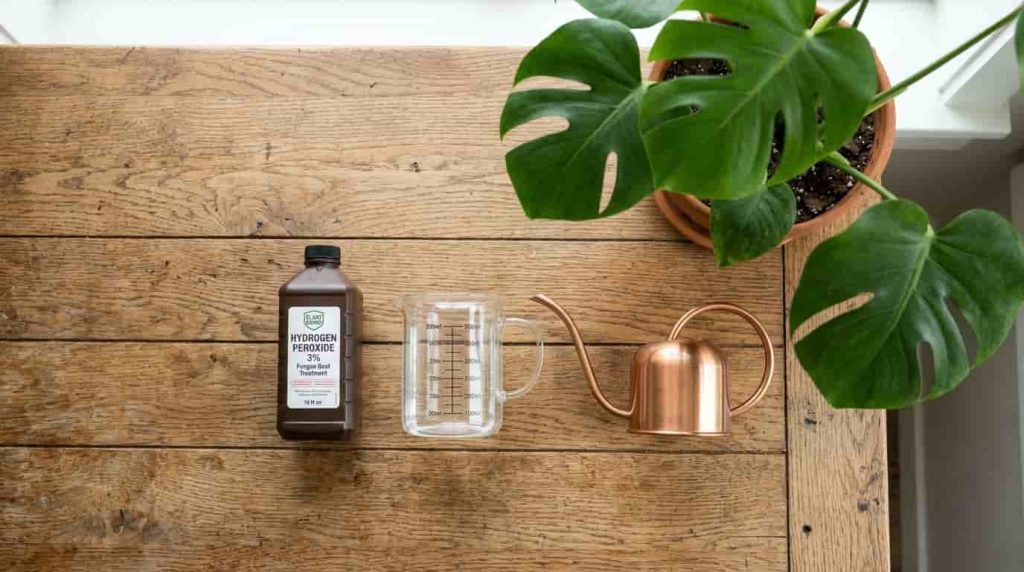
- Fresh 3% hydrogen peroxide (check the expiration date, old bottles lose strength)
- Room-temperature tap or filtered water
- A measuring cup and a clean watering can or jug
- Yellow sticky traps
- A saucer or tray for catching drainage
- Gloves, if your skin is sensitive
Skip the spray bottle for now. The drench is the main event.
Step-by-Step Soil Drench
Here’s the routine I follow. It’s boring, and boring works.
- Let the top inch or two of soil dry out first. Peroxide on already-soggy soil just adds more moisture to the problem.
- Mix 1 part 3% peroxide with 4 parts room-temperature water in a clean jug.
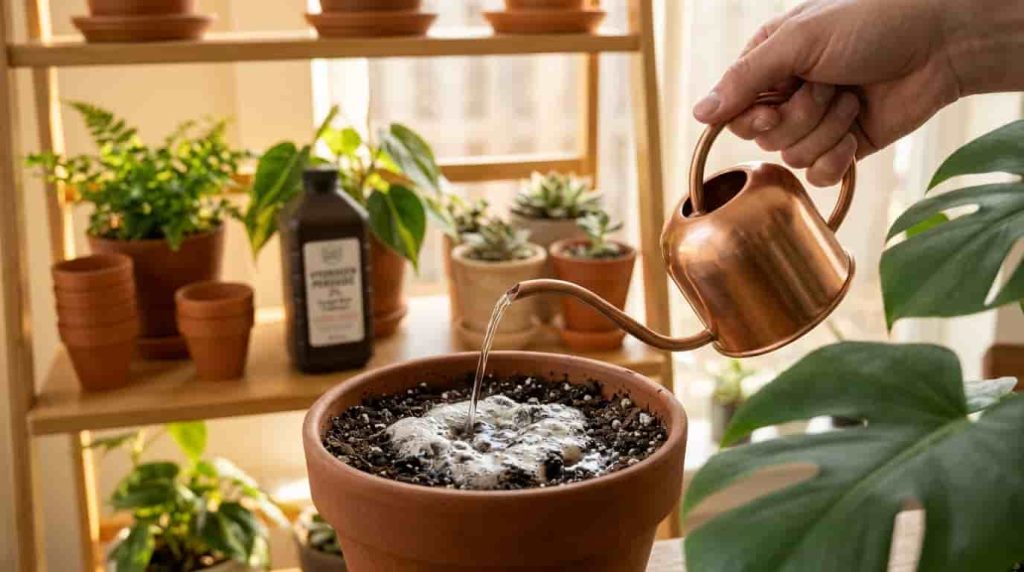
- Pour slowly over the whole soil surface, not just one spot. Aim for the soil, not the leaves.
- Keep pouring until it drains from the bottom holes. That flushes the solution through the entire root zone.
- Expect fizzing. It’s normal and it stops within a few minutes.
- Empty the saucer so the pot isn’t sitting in leftover liquid.
- Put out yellow sticky traps at soil level, because adults hover low.
Some people prefer to bottom-soak the pot. That works, but a top drench reaches the surface larvae better, since they live in the top few inches.
Don’t spray the leaves. This is a soil job.
The Retreatment Schedule
Here’s where most people quit too early.
A fungus gnat goes from egg to adult in roughly three to four weeks at room temperature. One drench won’t catch every life stage, so you have to repeat it. (That timeline is general gardening knowledge rather than a hard number, and warmer rooms run faster.)
My go-to plan looks like this:
- Day 1: First drench, plus sticky traps in every infested pot.
- Day 5 to 7: Second drench, after the top inch of soil has dried.
- Day 12 to 14: Third drench.
- Day 19 to 21: Final drench, then keep traps up for another week.
Check the traps every few days. When they stop catching new adults for a full week, you’re likely in the clear.
Skip a repeat if the soil is still wet. Water only when the top inch is dry, even on treatment days.
Soil Mix, Watering, and Light
Look, here’s the thing. Peroxide treats the symptom. Wet soil is the disease.
Overwatering is the leading culprit, since damp soil supports both their eggs and their food sources of fungus and decaying organic matter. Fix the moisture and half your problem disappears.
Soil mix. Dense, peat-heavy potting soil stays wet for ages. Mix in perlite, coarse bark, or pumice so water drains fast and air reaches the roots.
For most houseplants, I like a mix that’s around one-third amendments by volume. It’s a rule of thumb, not a science.
Top layer. A half inch of coarse sand or fine grit on the surface makes it hard for females to lay eggs. A sand layer prevents new eggs, so pairing it with a peroxide or BTI drench gives both immediate larval kill and long-term prevention.
Watering routine. Stick a finger in the soil. If the top one to two inches feel damp, wait. Letting the top 1 to 2 inches dry between waterings makes it much harder for gnats to lay eggs and larvae to survive.
Bottom watering helps too. Set the pot in a tray of water for 15 to 20 minutes, then drain, and the surface stays drier.
Light. This one gets ignored. Plants in dim corners use less water, so their soil stays wet longer, and gnats love that.
Move struggling pots closer to a bright window, if the plant can handle it. Brighter light means faster drying and fewer breeding opportunities.
Which Plants Handle Peroxide (and Which Don’t)
Most mature houseplants tolerate a 1:4 drench just fine. A few don’t.
Usually tolerant:
- Pothos, philodendron, and monstera
- Snake plants and ZZ plants
- Rubber plants and dracaena
- Spider plants
Test first, or use the gentler 1:8 mix:
- Ferns and calatheas
- Maidenhair ferns and other fine-rooted plants
- African violets and other fuzzy-leaved plants
- Orchids in bark (the roots are exposed and sensitive)
One source recommends testing on a single pot first for sensitive types. It notes that plants like ferns and calathea may need a more diluted ratio.
My rule is simple. Test on one pot, wait 48 hours, and look for yellowing, drooping, or brown root tips.
Edible herbs are fine too, but let the plant rest a few days before harvesting. Basil and mint sulk when over-treated.
Seedlings and Cuttings
Be careful here.
Seedlings and fresh cuttings have tender, tiny roots. The extension expert mentioned above said they wouldn’t use peroxide on seedlings at all. Instead, they recommended fresh soil-less mix in clean containers so gnats shouldn’t be an issue.
If you must treat seedlings, use the weaker 1:8 mix and treat once before reassessing. I’d rather swap the sterile mix and add a sand layer.
Propagation jars with water-rooting cuttings don’t need soil treatment. Just change the water and keep a sticky trap nearby.
Pairing Peroxide With Other Controls
Peroxide works best as part of a combo. Here’s how the common options compare, in plain terms:
- Hydrogen peroxide drench: Kills larvae on contact. Cheap, fast, no residue, but needs repeating and may harm beneficial soil microbes.
- Yellow sticky traps: Catch adults and show you if the problem is shrinking. They don’t touch larvae.
- BTI (Bacillus thuringiensis israelensis): A soil bacterium whose proteins kill fungus gnat larvae and some other insects. Great for long-term control, available as mosquito dunks or products.
- Beneficial nematodes: Steinernema nematodes are parasites that attack the larval stage and have been used alone or with BTI. Ideal for big collections or greenhouses.
- Neem oil drench: Gives several days of residual activity in the soil, where peroxide breaks down right away.
- Sand or grit top layer: Stops egg-laying. Zero chemicals.
My favorite combo is peroxide for the first strike, then BTI for ongoing protection. Don’t apply them the same day, though, since peroxide may harm the bacteria you’re trying to introduce.
(Source: USDA or University Integrated Pest Management Study)
Troubleshooting: Why It Didn’t Work
Gnats still buzzing? Run down this list.
- Wrong insect. Re-check with the potato slice. Fruit flies ignore soil treatments.
- Mix too weak. Measure properly. Eyeballing leads to a sad 1:10 situation.
- Old peroxide. A bottle that’s been open for a year has lost strength. Replace it.
- Soil never dried. Peroxide plus constant wetness equals new eggs within days.
- You stopped after one treatment. Eggs and pupae survive the first drench, so repeat on schedule.
- Untreated nearby pots. Gnats move between plants. Treat every pot, even ones that look fine.
- Gnats in the potting bag. Contaminated soil brings a fresh generation. Store bags sealed and dry.
- Trays and saucers. Algae-covered or soggy saucers can host larvae. Clean them with soapy water.
Still stuck after four weeks? Repot into fresh, fast-draining mix, rinse the roots gently, and wash the pot.
Honestly, that’s what finally ended my worst infestation. (My living room looked like a jungle and every plant had to be checked.)
Safety Rules
Hydrogen peroxide is mild at 3%, but it’s still a chemical.
- Use only 3% (or dilute stronger products correctly). Never use 35% around pets, kids, or your eyes.
- Store the bottle in a cool, dark place, away from light.
- Wear gloves if your skin is sensitive, and avoid splashing your eyes.
- Never mix peroxide with vinegar or bleach.
- Keep treated pots away from pets until the soil is dry.
One more thing. Peroxide is a strong oxidizer, so it can kill beneficial microorganisms in your soil, which is why this source advises keeping treated plants well fertilized and refreshing the soil. Don’t treat weekly forever.
Treat when you have gnats. Stop when they’re gone.
Prevention Checklist
Once the gnats are gone, keep them gone.
- Water only when the top inch or two is dry.
- Use fast-draining potting mix with perlite or bark.
- Add a thin layer of sand or grit on top.
- Empty saucers 15 minutes after watering.
- Quarantine new plants for two weeks and keep a sticky trap nearby.
- Keep a yellow sticky trap in a few pots all year as an early warning.
- Clean up fallen leaves and dead plant material from the soil surface.
- Store opened potting mix in a sealed bucket.
Read: 15 Best Low Light Indoor Plants for Apartments
FAQ
How do I get rid of fungus gnats with hydrogen peroxide ratio mixing?
Mix 1 part 3% hydrogen peroxide with 4 parts room-temperature water. Pour it over the soil until it drains from the pot, then repeat every 5 to 7 days for about three weeks. Add yellow sticky traps to catch the adults.
Does hydrogen peroxide kill fungus gnat larvae and eggs?
It kills larvae it touches on contact, and some sources say it affects eggs too. Pupae and adults often survive the first drench, which is why repeat treatments matter. A single application rarely ends an infestation in my experience.
Will hydrogen peroxide harm my houseplants?
At the 1:4 ratio, most mature plants tolerate it well. Sensitive plants like ferns and calathea do better with a gentler 1:8 mix, and seedlings are best left untreated. Always test one pot first and watch for yellowing or drooping.
How long does it take to get rid of fungus gnats?
Expect about three to four weeks, since you’re breaking an entire life cycle. You should see fewer adults within a week, but keep treating on schedule. Dry soil and sticky traps speed up the process.
The Final Word
Knowing how to get rid of fungus gnats with hydrogen peroxide ratio basics is half the battle: 1 part 3% peroxide to 4 parts water, poured on dry-ish soil, repeated for three weeks. The other half is fixing the wet soil that invited them in the first place.
Drench, trap, dry out, repeat. Do that, and your plants get their peace back.
You’ve got this.
2 thoughts on “How to Get Rid of Fungus Gnats With Hydrogen Peroxide Ratio: The Exact 1:4 Mix and Schedule That Works”