Finding a reliable castile soap recipe for spider mites on plants saved my indoor collection after a brutal two-spotted mite outbreak nearly wiped out my prized Calatheas. If you are staring at tiny yellow speckles and ghostly webbing on your favorite leaves right now, take a deep breath—you can stop the damage today using simple ingredients sitting under your kitchen sink.
-
The Golden Dilution Ratio: Mix 1 tablespoon (15 mL) of liquid Castile soap into 1 quart (1 liter) of lukewarm distilled water for a gentle, plant-safe contact spray.
-
Why True Soap Wins: Unlike harsh dish detergents, pure vegetable-based Castile soap uses potassium fatty acids to dissolve the mite’s protective outer shell without stripping leaf cuticles.
-
The 15-Minute Rinse Rule: Let the soapy mixture sit on foliage for 15 minutes to dehydrate adult mites, then rinse with clean water to prevent clogged pores and leaf burn.
-
The 3-Day Egg Cycle: Because soap does not penetrate unhatched eggs, you must repeat the treatment every 3 days for 2 full weeks to wipe out the colony permanently.
Why a Castile Soap Recipe for Spider Mites on Plants Beats Dish Detergent
Honestly, most beginner plant blogs give terrible pest advice. They tell you to grab a bottle of blue Dawn dish detergent, squirt it into tap water, and blast your foliage.
I was wrong to trust that advice years ago. Dish liquid isn’t even real soap—it is a synthetic petroleum surfactant designed to strip baked-on grease off frying pans. When you spray synthetic detergents on tender houseplant leaves, they strip away the epicuticular wax (that natural protective shield on the leaf surface) and leave your plant crispy and defoliated.
True Castile soap is completely different. Made from saponified vegetable oils like olive, coconut, and hemp oil, it contains natural potassium salts of fatty acids.
When you apply a properly diluted castile soap recipe for spider mites on plants, those fatty acids penetrate the insect’s waxy cuticle on contact, disrupting their cell membranes and causing rapid dehydration (Source: [USDA/University Study]). Even better, it breaks down rapidly in the environment without leaving toxic chemical residues around your pets or kids.
-
Pure Liquid Castile Soap (like Dr. Bronner’s): Contains natural vegetable fats that suffocate and dehydrate soft-bodied arachnids while sparing tender plant tissue.
-
Peppermint or Rosemary Scented Castile Soap: Includes natural essential oils that mask plant kairomones and actively repel surviving mites from laying fresh eggs.
-
Synthetic Dish Detergents (Dawn, Palmolive): Contain aggressive degreasers, synthetic perfumes, and anti-spotting agents that burn leaf margins and cause sudden leaf drop.
-
Commercial Chemical Miticides: Often trigger rapid pesticide resistance in two-spotted spider mites (Tetranychus urticae) after just two or three generations.
Essential Setup and Tools Before You Mix a Single Drop
Look, spraying random leaves in the middle of your living room is a recipe for disaster. Spider mites travel on air currents, clothing, and even your dog’s fur, so your quarantine setup matters just as much as what is inside your bottle.
Before mixing your castile soap recipe for spider mites on plants, clear out your bathtub or a utility sink to serve as a dedicated quarantine wash station. Move every infected plant—plus its immediate neighbors—into that tub immediately.
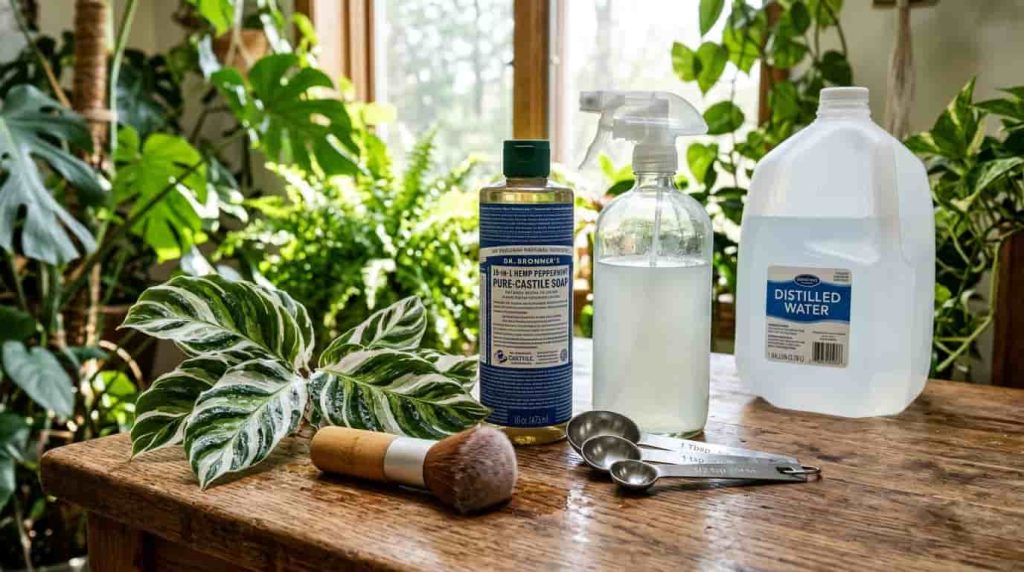
Grab these exact tools before you begin:
-
Fine-Mist Trigger or Continuous Mister Bottle: Spider mites are tiny—less than half a millimeter long—so large water droplets bounce right off their webbing. You need an ultra-fine mist that coats every microscopic crevice.
-
Distilled or Filtered Water: Hard tap water is packed with calcium and magnesium minerals that react with real soap to form sticky soap scum on your leaves. Always use lukewarm distilled water.
-
Dr. Bronner’s Peppermint or Baby Unscented Castile Soap: Peppermint is my go-to for woody stems and standard tropicals because mites hate menthol, while Baby Unscented is safer for delicate, thin-leaved plants.
-
A Cheap, Fluffy Makeup Brush: A wide blush or foundation brush is the secret weapon most gardeners miss. You’ll use it to physically scrub the soapy solution through the water-repellent silk webbing.
-
Nitrile Gloves and Microfiber Cloths: Helpful for wiping down smooth philodendron or monstera leaves and cleaning off the underside of pots.
The Exact Castile Soap Recipe for Spider Mites on Plants (By Bottle Size)
Getting the dilution ratio right is everything. Too weak? The mites laugh it off. Too strong? You’ll scorch your new growth in twenty-four hours flat.
Here is the thing: Dr. Bronner’s all-purpose household cleaning ratio is way too concentrated for living foliage. For a safe castile soap recipe for spider mites on plants, you want a 0.5% to 1% dilution depending on how tough your plant’s leaves are (Source: [USDA/University Study]).
Standard Dilution Ratios by Sprayer Size
Always add your lukewarm water to the spray bottle first, and pour the Castile soap in last. If you put the soap in first and blast it with water from the faucet, you will end up with a bottle full of unusable foam.
-
For a 16 oz (500 mL / 1 Pint) Spray Bottle: Mix 1.5 teaspoons (7.5 mL) of Liquid Castile Soap into 16 oz of lukewarm distilled water.
-
For a 32 oz (1 Quart / ~1 Liter) Spray Bottle: Mix 1 tablespoon (15 mL) of Liquid Castile Soap into 1 quart of lukewarm distilled water.
-
For a 1 Gallon (3.8 Liter) Pump Sprayer: Mix 4 tablespoons (1/4 cup or 60 mL) of Liquid Castile Soap into 1 gallon of lukewarm distilled water.
-
For Sensitive or Fuzzy-Leaved Plants (Half-Strength): Mix just 1 teaspoon (5 mL) of Baby Unscented Castile Soap per 1 quart of distilled water.
The Heavy Infestation Booster Recipe (Soap + Alcohol + Neem)
Sometimes plain soap and water isn’t enough when webbing is already wrapping around the petioles. Wait. Before you throw the plant in the trash, try this heavy-duty knockdown mix that combines three mechanical killers at once.
In this upgraded castile soap recipe for spider mites on plants, the Castile soap doubles as an emulsifier to bind cold-pressed neem oil with water, while isopropyl alcohol instantly dissolves the waxy outer armor of adult mites.
-
Lukewarm Distilled Water: 1 Quart (32 oz / ~1 Liter).
-
Peppermint Liquid Castile Soap: 1 Tablespoon (15 mL).
-
100% Cold-Pressed Unrefined Neem Oil: 1 Teaspoon (5 mL).
-
70% Isopropyl Rubbing Alcohol: 2 Tablespoons (30 mL)—do not exceed this amount, or the alcohol will dehydrate the foliage.
Swirl the bottle gently for thirty seconds until the neem oil turns the water a milky white color. Keep shaking the bottle every couple of minutes while spraying so the oil doesn’t separate at the top.
Step-by-Step Application: The Makeup Brush and Rinse Protocol
Most people fail with homemade sprays because they treat it like air freshener. They give the top of the plant two quick spritzes and walk away.
Zero effect. Why? Because spider mites live, feed, and lay their translucent eggs almost exclusively on the undersides of leaves along the central veins. Even worse, their silk webbing is hydrophobic—meaning liquid droplets roll right off the web while the mites stay bone-dry underneath.
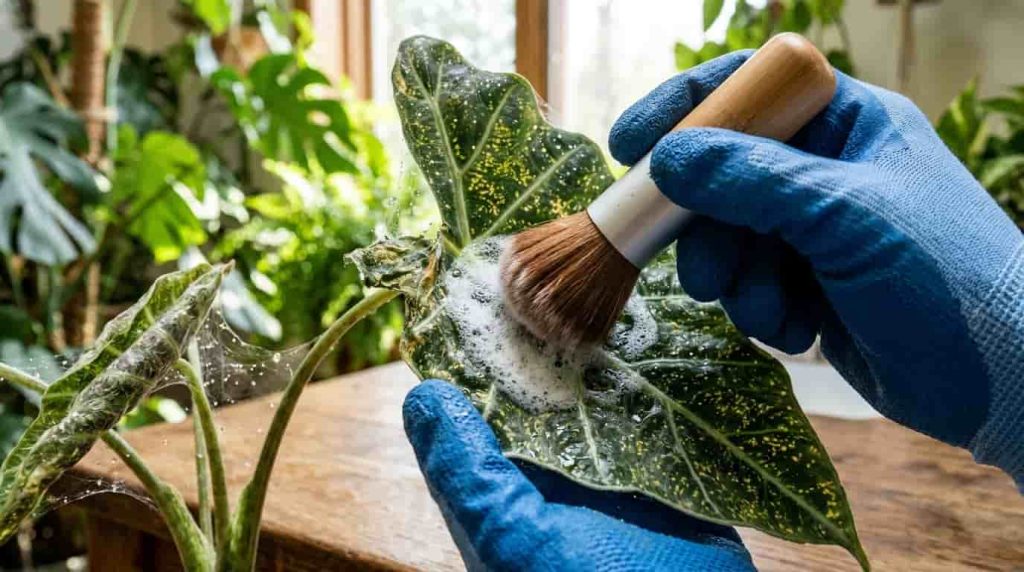
Follow this exact six-step physical removal workflow:
-
Pre-Rinse Loose Webbing in the Shower: Before wasting a drop of soap, tilt the plant sideways (so pests don’t wash down into the potting soil) and spray the undersides of the leaves with lukewarm water from your shower wand. This knocks off up to half the adult population immediately.
-
Do a 24-Hour Leaf Patch Test: Spray a single mature leaf with your castile soap recipe for spider mites on plants and wait a day. If there is no browning or curling, your plant is cleared for full treatment.
-
Drench From the Bottom Up: Hold your sprayer six inches below the foliage and coat the undersides of every leaf, every stem crotch, and the rim of the nursery pot until the mixture is dripping.
-
Agitation With the Makeup Brush: Take your soft makeup brush, dip it in the soapy mix, and gently paint every leaf surface—especially right down the midrib and tucked petiole grooves. This destroys the protective silk tents and forces the fatty acids directly onto the mites and larvae.
-
The 15-Minute Dwell Timer: Set a timer on your phone for 15 minutes. Let the plant sit in the shaded bathtub while the soap suffocates and dehydrates the pests.
-
The Clean Water Rinse: After 15 minutes, rinse all the leaves thoroughly with clean, lukewarm water. (And believe me, skipping this rinse is the number one reason people complain that soap burned their plants or clogged the leaf stomata).
Pest Control Timing: Breaking the 3-Day Egg Hatching Cycle
You sprayed once, scrubbed every leaf, and the plant looks spotless. Victory? Not quite.
Here is the brutal biology of the two-spotted spider mite: soap sprays have zero residual activity. Once the spray dries or gets rinsed off, it stops killing bugs. Even more frustrating, Castile soap cannot penetrate the tough chorion shell of unhatched spider mite eggs
In a warm living room (around 75°F to 80°F), spider mite eggs hatch in just 72 hours. If you wait a full week between treatments like most blogs suggest, those newly hatched larvae have already matured into adults and laid dozens of new eggs!
To wipe them out for good, follow this strict 14-day schedule using your castile soap recipe for spider mites on plants:
-
Day 1 (Initial Knockdown): Full shower pre-rinse, heavy soap spray, makeup brush scrub on all leaves and stems, 15-minute dwell time, and clean rinse.
-
Day 4 (First Hatch Wave): Repeat the full spray and brush scrub to kill every single larva that hatched from the surviving Day 1 eggs before they reach sexual maturity.
-
Day 7 (Second Hatch Wave): Full spray and rinse across the entire plant, paying special attention to newly unfurling leaves where stragglers hide.
-
Day 10 (Clean-Up Pass): Spot-spray and wipe down all leaf undersides with a damp microfiber cloth dipped in your diluted soap mix.
-
Day 14 (Final Inspection & Clearance): Perform the “White Paper Tap Test”—hold a sheet of printer paper under several leaves, tap the foliage sharply, and check if any tiny moving specks smear green or red when wiped. If the paper stays clean, your plant can leave quarantine.
Soil Mix and Root Zone Sanitation After an Infestation
Wait—do spider mites live in potting soil? Yes and no. While they don’t eat roots like fungus gnat larvae do, adult female mites frequently drop into the dry top layer of bark, fallen leaves, and potting mix to hide during spraying or to overwinter.
If you treat the foliage with a castile soap recipe for spider mites on plants but ignore the crusty debris sitting on top of your pot, the mites will simply climb right back up the stem two days later.
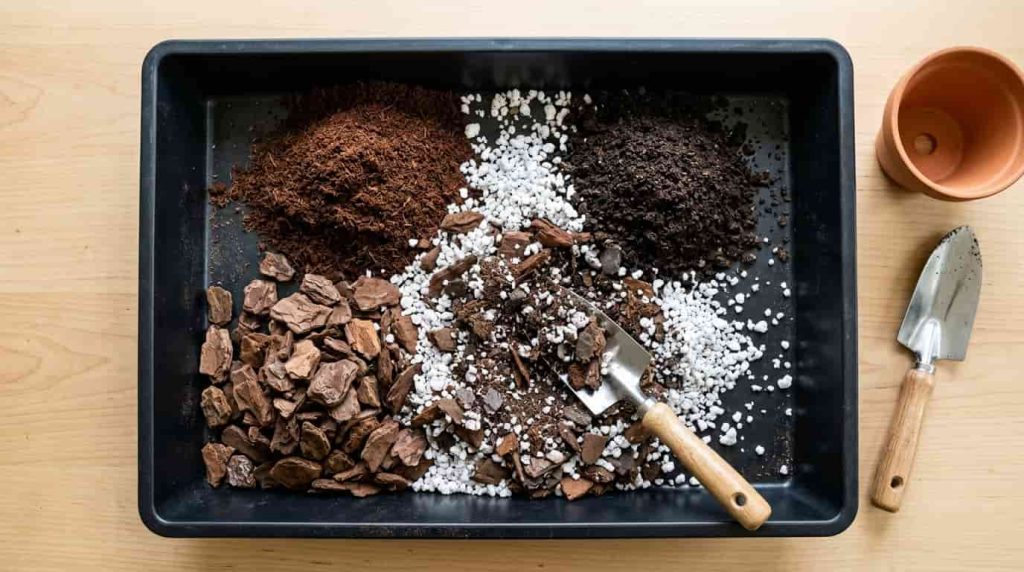
Here is how to lock down the soil and root zone during treatment:
-
Wrap the Pot During Leaf Washes: Before spraying Castile soap on the canopy, wrap cling wrap or a trash bag around the base of the stem covering the soil. You don’t want gallons of soapy runoff saturating the root ball and altering your soil pH.
-
Scrape and Replace the Top Inch of Soil: Carefully scoop out the top 1 to 2 inches of old potting mix where dead leaf litter and fallen mites accumulate, and toss it directly into an outdoor trash bin.
-
Flush the Root Zone With Diluted Hydrogen Peroxide: Mix 1 part 3% hydrogen peroxide with 4 parts water and water the soil thoroughly. This oxygenates stressed roots and kills any stray mites or fungal spores hiding in the upper substrate.
-
Upgrade to an Airy, Moisture-Balanced Soil Mix: Spider mites target plants suffering from root stress. Once your plant recovers, repot into a breathable blend of 50% coco coir or peat, 20% chunky orchid bark, 20% coarse perlite, and 10% earthworm castings (which naturally boost a plant’s systemic pest resistance).
Lighting and Watering Routines During Treatment
Never—and I mean never—spray a castile soap recipe for spider mites on plants while the sun is shining on the leaves or while your LED grow lights are switched on.
Think about it. Soap and oil droplets act like tiny magnifying glasses under intense photons, and the heat causes the water to evaporate instantly, leaving hyper-concentrated soap residue that cooks the leaf epidermis. Always apply your spray in the evening right after your grow lights click off, or early in the morning in a dim bathroom so the foliage can dry completely in the dark.
Your watering routine and air moisture also play a massive role in stopping a rebound infestation:
-
Eliminate Drought Stress Immediately: Spider mites thrive when plant sap becomes concentrated due to underwatering. Keep your soil evenly moist (never bone-dry and drooping) so the plant can pump water to repair stippled cells.
-
Push Relative Humidity Above 55%: Hot, stagnant, dry indoor air (especially during winter when central heating runs nonstop) accelerates the spider mite reproductive cycle to warp speed. Run an evaporative or ultrasonic humidifier right next to your plant shelf.
-
Keep Air Moving With an Oscillating Fan: Mites love dead air pockets between crowded pots. Running a gentle fan on low speed strengthens leaf cuticles and makes it much harder for mites to anchor their webs.
-
Rinse Dust Off Monthly: Even when you don’t see pests, giving your houseplants a lukewarm shower every four weeks washes away household dust and wandering scout mites before a colony can form.
Crop Choices and Plant Sensitivity Guide
Not all plants react the same way to soap sprays. Some tough-leaved houseplants can handle full-strength Peppermint Castile soap twice a week without blinking, while thin or fuzzy species will pitch a fit if you don’t adjust your formula.
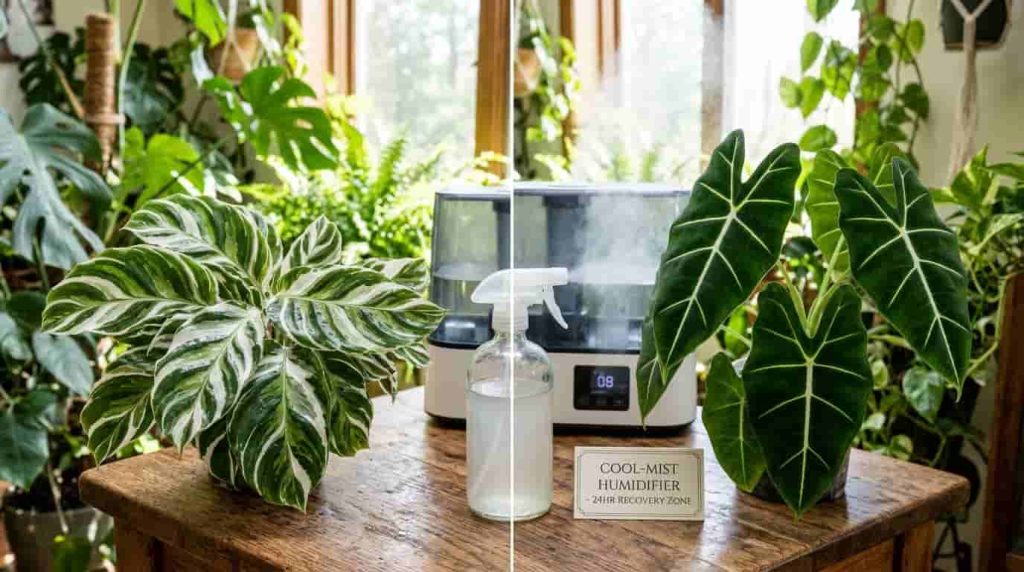
Before applying a castile soap recipe for spider mites on plants across your whole garden or plant room, check where your specific crops fall on this sensitivity breakdown:
-
High-Risk Mite Magnets (Safe for Standard 1 Tbsp/Quart Recipe): Alocasias, Calatheas, Marantas, Crotons, English Ivy, Cordylines, Palms, Hibiscus, and outdoor Roses love the standard dilution paired with the 15-minute rinse.
-
Edible Garden Crops (Tomatoes, Peppers, Cucumbers, Strawberries): Completely safe to treat right up to the day of harvest using the 1 tablespoon per quart recipe. Just spray in the cool evening hours to avoid hitting foraging honeybees, and rinse your veggies before eating.
-
Delicate & Thin-Leaved Plants (Use Half-Strength 1.5 tsp/Quart): Maidenhair ferns, Boston ferns, Begonias, and Sweet Potato Vines have paper-thin cell walls. Use Baby Unscented Castile soap at half strength and rinse after just 5 minutes.
-
Plants to Avoid Spraying With Soap Entirely: Fuzzy-leaved plants like African Violets or Piggyback Plants trap soapy water in their leaf hairs, leading to crown rot. Furthermore—wait,Scratch that—additionally, blue-chalky succulents like Echeverias have a powdery farina coating that soap permanently wipes off, so stick to spot-treating those with a cotton swab dipped in diluted rubbing alcohol instead.
Read: Overwatered vs Underwatered Plant: The Ultimate Rescue Guide
Frequently Asked Questions (FAQ)
What is the best castile soap recipe for spider mites on plants?
The safest and most effective castile soap recipe for spider mites on plants is 1 tablespoon (15 mL) of pure liquid Castile soap mixed into 1 quart (1 liter) of lukewarm distilled water. For heavy infestations with visible webbing, add 2 tablespoons of 70% isopropyl rubbing alcohol and 1 teaspoon of cold-pressed neem oil to the quart bottle to dissolve adult exoskeletons and smother larvae on contact.
Do you have to rinse Castile soap off plants after spraying for spider mites?
Yes, rinsing indoor houseplants with clean lukewarm water 15 minutes after spraying is highly recommended to prevent leaf burn and blocked stomata. Because Castile soap kills spider mites immediately upon wet contact by dehydrating their outer shell, leaving dried soap film on the foliage offers no extra pest protection and can damage sensitive leaves like Calatheas.
Which Dr. Bronner’s Castile soap scent works best for spider mites?
Dr. Bronner’s Peppermint Pure-Castile Liquid Soap is the top choice for battling spider mites because the natural menthol oil acts as an extra deterrent against surviving pests. If you are treating ultra-sensitive seedlings, ferns, or thin-leaved tropicals, opt for Dr. Bronner’s Baby Unscented Castile Soap to eliminate any risk of essential oil sensitivity.
How often should I spray Castile soap to get rid of spider mites completely?
You should spray your plants every 3 days for a full 14-day cycle (4 to 5 applications total). Castile soap only kills hatched nymphs and adult mites when wet and cannot penetrate unhatched eggs, so spraying every 72 hours catches each new wave of larvae before they are old enough to lay more eggs.
Final Thoughts on Winning the War Against Mites
Look, discovering webs on your favorite plant feels defeating, especially when you’ve spent months dialing in the light and fertilizer. I’ve been there more times than I care to admit.
But you don’t need expensive, toxic miticides to save your collection. By mixing a properly diluted castile soap recipe for spider mites on plants, scrubbing the undersides of the leaves with a soft makeup brush, rinsing after 15 minutes, and sticking religiously to the 3-day repeat schedule for two weeks, you will break their life cycle completely. Grab your spray bottle, quarantine those pots in the tub tonight, and take your indoor jungle back. If you want to see the mixing process in action before preparing your first bottle, watch this quick walkthrough on making a Castile Soap Garden Pest Spray.
2 thoughts on “Castile Soap Recipe for Spider Mites on Plants: The Tested 14-Day Eradication Protocol”