Finding tiny jumping bugs in houseplant soil can send any apartment plant parent into an absolute panic. I see this exact freak-out every spring when indoor temperatures rise and soil moisture spikes.
What are the tiny jumping bugs in houseplant soil?
Those tiny jumping bugs in houseplant soil are almost always springtails (Collembola). They are harmless, moisture-loving hexapods that feed on decaying organic matter, fungi, and mold. They do not bite humans, damage healthy roots, or eat living plant tissue. Their presence simply indicates your potting mix is staying too wet.
Environmental Triggers for Tiny Jumping Bugs in Houseplant Soil
When you spot tiny jumping bugs in houseplant soil, your apartment’s microclimate is the true culprit. Springtails thrive when your environment lacks proper airflow and light, forcing the soil to stay wet for weeks.
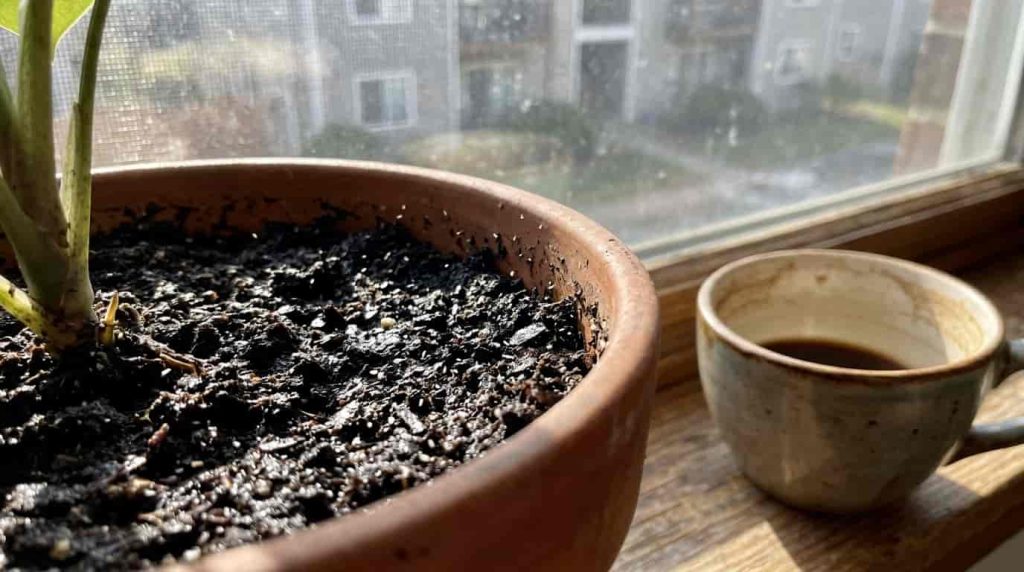
Dialing in Indoor Light Metrics (PPFD & Foot-Candles)
Most people who live in apartments wildly overestimate how much light their plants are getting. Tropical plants need 100 to 400 µmol/m2/s of Photosynthetic Photon Flux Density (PPFD). This will dry out your potting mix quickly and help prevent tiny jumping bugs in houseplant soil. In standard foot-candles (FC), this is approximately 500 to 2,000 FC during the peak daylight hours.
An unobstructed south-facing window provides maximum light, but direct afternoon sun through glass can burn foliage. Pull sensitive plants back 2 to 3 feet from a south window to diffuse the intensity. Conversely, an east-facing window offers gentle morning light hitting around 150 to 300 FC, making it perfect for understory plants like Calatheas or ferns.
Temperature and Humidity Thresholds
Your apartment thermostat dictates how fast your plants drink. Keep daytime temperatures strictly between 65°F and 85°F, allowing nighttime temps to drop slightly but never below 60°F. If your apartment dips into the 50s, plant metabolism stalls, soil stays wet, and tiny jumping bugs in houseplant soil multiply rapidly.
Relative humidity should hover between 45% and 60% for most standard houseplants. Pushing humidity above 70% in a stagnant apartment without oscillating fans is a recipe for surface mold. That mold acts as an all-you-can-eat buffet for tiny jumping bugs in houseplant soil.
Exact Container Sizes and Drainage Mechanics
Putting a small root system in a massive pot guarantees stagnant water. Always choose a pot that is only 1 to 2 inches larger in diameter than the plant’s current rootball.
If your 4-inch Pothos goes into an 8-inch ceramic pot, the excess soil will never dry out. Furthermore, your container must have at least one 0.5-inch drainage hole at the absolute bottom. Decorative cachepots with zero holes require you to keep the plant in its plastic nursery pot so you can remove it for weekly watering.
Soil, Substrate & Nutrition Masterclass
To permanently evict tiny jumping bugs in houseplant soil, you must completely overhaul your substrate. Standard store-bought potting soil is far too dense for apartment environments and holds water like a sponge.
The Ultimate Aroid Soil Mix Recipe
You need a well-aerated mix to starve out tiny jumping bugs in houseplant soil by allowing oxygen to reach the roots. Mix 4 cups of high-quality indoor potting soil (peat or coco coir based) as your moisture-retaining base. Add 2 cups of chunky orchid bark (fir bark) to create large macropores for root expansion.
Finally, fold in 2 cups of coarse perlite or pumice to maximize drainage speed. This 4:2:2 ratio guarantees water flushes through the pot in seconds rather than pooling at the bottom. (Source:USDA/University Extension)
Managing Soil pH for Nutrient Uptake
If your soil pH is off, your plant cannot absorb fertilizer, leading to weak growth and wet pots. The ideal soil pH range for most tropical houseplants sits between 5.5 and 6.5.
Peat moss naturally acidifies the soil over time, which most tropicals prefer. However, if your tap water is highly alkaline, it can push the soil pH above 7.0, locking out iron and magnesium.
Rule of Thumb: If your tap water tastes heavily mineralized, let it sit out for 24 hours to off-gas chlorine, or switch to distilled water for sensitive species like Marantas.
Read The Guide: Rubbing Alcohol on Succulents for Mealybugs: How to Kill Pests Without Burning Leaves
Granular NPK Fertilizer Schedule
A hungry plant drinks slower, leaving your soil wet enough to attract tiny jumping bugs in houseplant soil. Use a balanced, water-soluble liquid fertilizer with an NPK ratio of 3-1-2 or 1-1-1.
During the active growth months (March through September), dilute the fertilizer to exactly half of the manufacturer’s recommended strength. Apply this half-strength mix every two weeks (or roughly 1/4 teaspoon per gallon of water). Pause all fertilizing from October through February when the plant enters winter dormancy.
Granular Step-by-Step Care & Watering Protocol
A sloppy watering routine is the number one reason people end up with tiny jumping bugs in houseplant soil. You must adapt your habits based on the season and the tactile feel of the dirt.
Spring and Summer Active Growth Routine
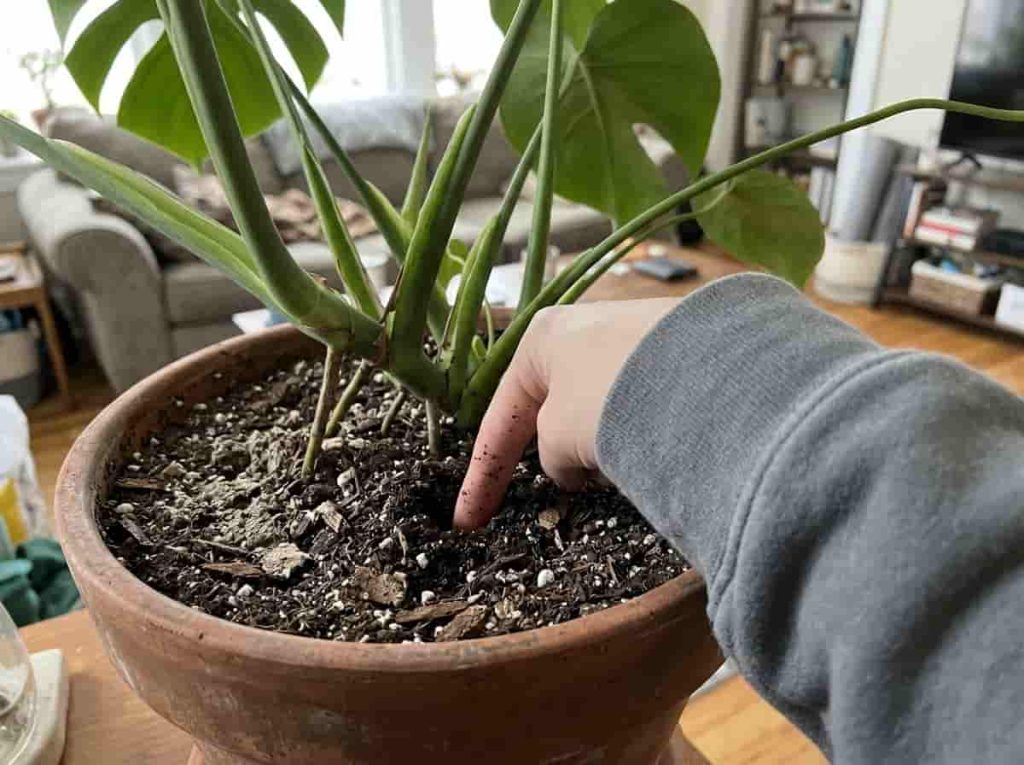
When daylight hours extend in the spring, your plants will consume water at double their winter rate. Test the moisture by physically pushing your index finger exactly 2 inches into the soil. If the tip of your finger feels dry, it is time to water thoroughly until liquid pours out the bottom drainage holes.
If it feels even slightly damp, wait two more days and check again. Never water your plants on a rigid weekly calendar; let the tactile moisture test guide you. This targeted dry-down period prevents tiny jumping bugs in houseplant soil from establishing breeding colonies.
Fall and Winter Dormancy Management
As apartment radiators kick on and days shorten, plant growth grinds to a halt. During winter, you should let the soil dry out significantly deeper—often 3 to 4 inches down.
Always empty the saucer beneath your pot exactly 15 minutes after watering. Leaving a plant sitting in its own cold runoff drastically drops the root temperature and invites immediate root rot.
Pest Comparison: Are Those Tiny Jumping Bugs in Houseplant Soil Actually Springtails?
Sometimes what you think are tiny jumping bugs in houseplant soil might actually be a different pest entirely. Use this scannable diagnostic table to confirm your enemy.
| Pest Name | Appearance & Movement | Location on Plant | Danger Level to Plant |
| Springtails | White, gray, or brown. 1/16-inch long. Jumps erratically when soil is disturbed. | Exclusively on the soil surface or in the runoff saucer. | Harmless. Feeds on decaying matter and fungus. |
| Fungus Gnats | Tiny black flies. Adults fly weakly; larvae are tiny white worms with black heads. | Adults fly near the soil; larvae live 1 inch deep in the dirt. | Moderate. Heavy larval populations can eat fine root hairs. |
| Soil Mites | Tiny white or brown dots that move slowly. They do not jump or fly. | Crawling on the soil surface or the outside of the pot. | Harmless. Decomposers that break down organic matter. |
| Flea Beetles | Tiny black/metallic beetles that jump like fleas. | Feeding directly on the leaves, leaving “shot-hole” damage. | Severe. Chews through healthy foliage rapidly. |
Information Gain & Myth-Busting Apartment Gardening
There is a shocking amount of terrible advice on social media regarding tiny jumping bugs in houseplant soil. Let’s dismantle the two worst myths costing you your plants.
Myth 1: Putting Rocks at the Bottom of the Pot Improves Drainage
This is the most destructive myth in indoor gardening. Placing gravel, clay pebbles, or broken terracotta at the bottom of a pot does not improve drainage. Instead, it creates a “perched water table.”
Water refuses to move from the fine-textured soil into the coarse rocks until the soil is 100% saturated. This traps a layer of completely waterlogged muck directly against the fragile lower roots. This stagnant, rotting layer is a paradise for tiny jumping bugs in houseplant soil. Always fill the entire pot with your uniform 4:2:2 soil mix instead.
Myth 2: Bottom Watering Prevents All Soil Pests
Bottom watering (letting the plant soak up water from a bowl) is great for hydrophobic peat moss, but it is not a silver bullet for pests. Capillary action will still pull moisture all the way to the top inch of the soil if you leave it soaking too long.
If the topsoil stays wet, tiny jumping bugs in houseplant soil will absolutely still breed there. Furthermore, bottom watering fails to flush out accumulated fertilizer salts.
Rule of Thumb: Always top-water your plants at least once a month so fresh water can actively flush built-up mineral salts out through the drainage holes.
Read More: Castile Soap Recipe for Spider Mites on Plants: The Tested 14-Day Eradication Protocol
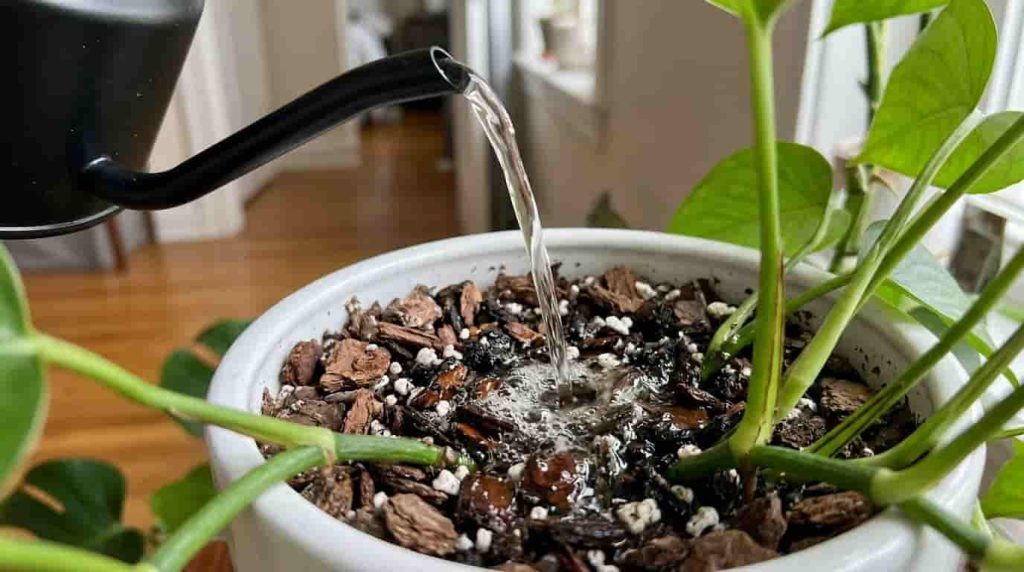
Advanced Troubleshooting & Pest Diagnostics
If you have tiny jumping bugs in houseplant soil, your plant might also be showing other signs of environmental stress. Here is how to diagnose and rescue your green investments.
Fixing Yellowing Lower Leaves
When the oldest leaves near the base of the plant turn a uniform, soft yellow, it is almost always overwatering. The roots are suffocating in the wet soil and cannibalizing older foliage to survive.
Remove the plant from its pot and inspect the roots. Healthy roots are firm and white or tan. If the roots are mushy, brown, and smell like a swamp, you have root rot. You must trim away the dead tissue with sterilized scissors, wash the remaining rootball with a 1-part hydrogen peroxide to 4-parts water solution, and repot in fresh, dry soil.
Curing Crispy Brown Tips
Brown, crispy tips on spider plants, calatheas, or peace lilies point directly to water quality issues or severe low humidity. Tap water heavily treated with fluoride or chloramine will slowly burn the leaf tips.
Switch to rainwater or distilled water immediately. Do not rely on misting your plants with a spray bottle; misting only raises the humidity for about five minutes before evaporating. Instead, group your plants closer together to create a humid microclimate, or invest in a small ultrasonic humidifier for your living room.
Stopping Leggy Etiolation
If your plant is pushing out massive gaps of bare stem between tiny, pale leaves, it is starving for photons. This stretching process is called etiolation. The plant is desperately reaching toward the nearest light source.
You cannot fix the existing stretched stem. You must prune the plant back to a healthy node and physically move the pot 3 to 4 feet closer to a sunny window. ([USDA/University Extension])
Eradicating Spider Mites
Spider mites are not tiny jumping bugs in houseplant soil; they are microscopic arachnids that attack the leaves. If you see dusty webbing near the stems and fine yellow stippling on the foliage, act fast.
Wipe down every single leaf (top and bottom) with a damp cloth. Then, spray the entire plant heavily with insecticidal soap or a diluted neem oil emulsion (1 tablespoon neem oil, 1 teaspoon gentle dish soap, 1 gallon warm water). Repeat this spray every 5 days for three weeks to break their hatching cycle.
Rule of Thumb: Spider mites absolutely hate high humidity and cold water, so giving your plant a brisk shower in the apartment bathtub is a fantastic first line of defense.
Managing Fungus Gnats vs Springtails
Unlike the harmless tiny jumping bugs in houseplant soil, fungus gnats fly around your face and their larvae eat root hairs. If you confirm gnats, deploy yellow sticky traps just above the soil line to catch the flying adults.
Next, mix 1 part 3% hydrogen peroxide with 4 parts water and drench the soil. This physically destroys the larvae on contact without harming the plant. For long-term prevention, water your plants with Mosquito Bits (Bacillus thuringiensis israelensis) soaked in your watering can.
When you maintain strict watering habits and utilize a chunky potting mix, tiny jumping bugs in houseplant soil will naturally pack up and leave on their own.
Frequently Asked Questions
Are tiny jumping bugs in houseplant soil harmful to humans or pets? No, springtails are completely harmless to humans, dogs, and cats. They do not bite, carry diseases, or infest your pantry food. They are strictly interested in the decaying organic matter and mold found in overly wet potting soil.
How do I permanently get rid of tiny jumping bugs in houseplant soil? The fastest way to eliminate them is to stop watering your plant for 10 to 14 days and let the top two inches of soil dry out completely. Without constant moisture, springtails cannot survive and will naturally die off. Repotting the plant into a chunky, well-draining soil mix prevents them from returning.
Can I use neem oil to kill tiny jumping bugs in houseplant soil? You can use a soil drench of diluted neem oil, but it is largely unnecessary for springtails. Because they only feed on decaying matter, altering your watering schedule is a much more effective and less messy solution than applying heavy horticultural oils indoors.
Why do I have tiny jumping bugs in houseplant soil during the winter? During winter, indoor plants enter dormancy and stop drinking water quickly, leaving the soil constantly damp if you maintain a summer watering schedule. Additionally, cold apartment floors keep the bottom of the pot wet for weeks. Always reduce your watering frequency by at least half during the winter months.
Will bottom watering stop tiny jumping bugs in houseplant soil? Bottom watering can help keep the top inch of the soil dry, which discourages springtails from congregating. However, if you leave the pot soaking in the basin for too long, capillary action will still saturate the entire rootball. Always pull the pot out of the water after 20 minutes to ensure it does not get waterlogged.
Do hydrogen peroxide drenches work on tiny jumping bugs in houseplant soil? Yes, mixing one part 3% hydrogen peroxide with four parts water will kill springtails and fungus gnat larvae on contact. The peroxide adds a burst of oxygen to the soil, which also helps combat early-stage root rot caused by the soggy conditions that attracted the bugs in the first place.