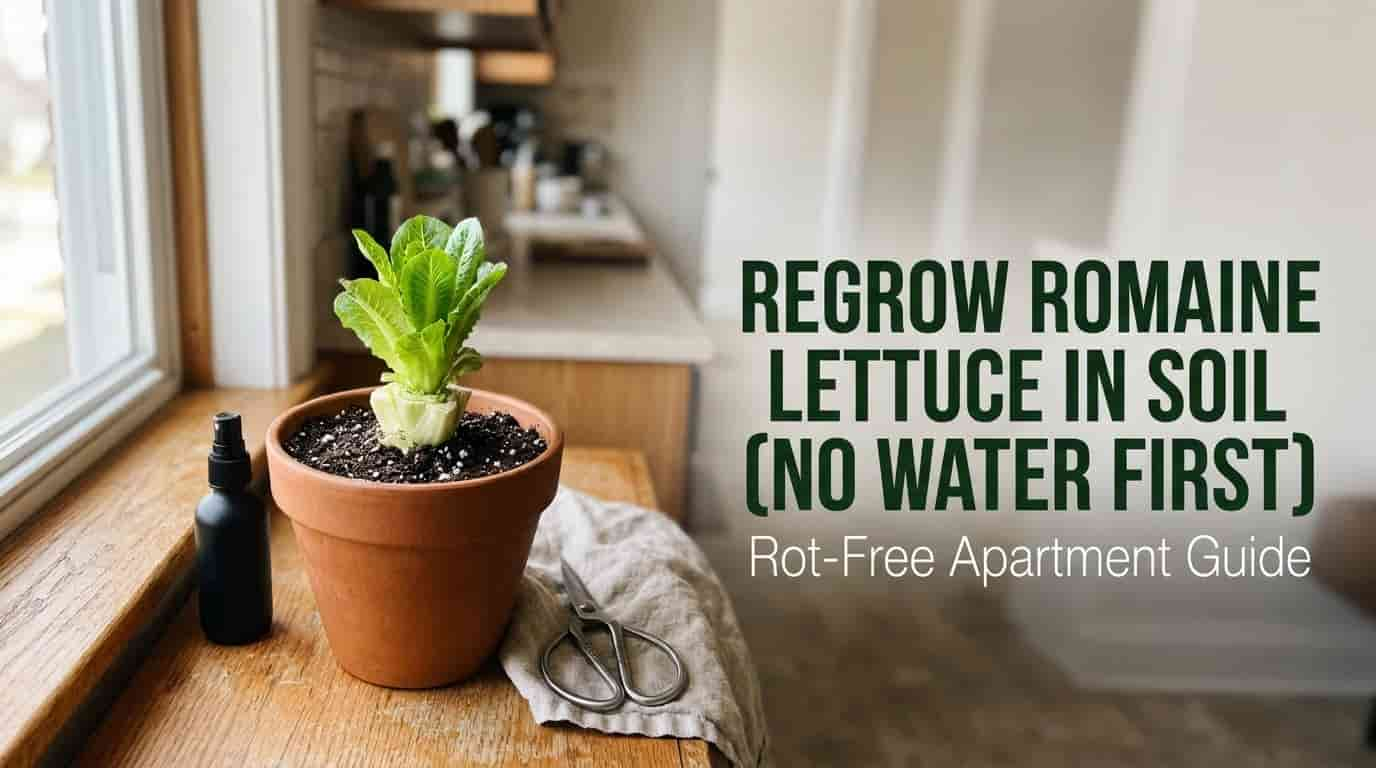
If you’ve ever tried to regrow romaine lettuce in soil without water first, you already know how frustrating that soggy, smelly bowl of water on the kitchen counter can be. Skipping the water-soaking phase entirely cuts out slimy bacterial decay and lets your store-bought romaine stump anchor directly into aerated potting mix.
Can You Regrow Romaine Lettuce in Soil Without Water First?
Yes, you can regrow romaine lettuce in soil without water first by slicing 1/4 inch off the calloused stem bottom, dusting it with rooting hormone, and planting it 1 inch deep in damp, well-draining potting mix. Direct soil planting prevents waterlogged rot and eliminates transplanting shock.
How to Regrow Romaine Lettuce in Soil Without Water First: Step-by-Step Setup
Most kitchen scraps gardening tutorials tell you to park your lettuce base in a shallow dish of water for a week. The problem is that submerged Lactuca sativa stems starve for oxygen and invite soft-rot bacteria like Pectobacterium before a single root hair appears.
Going straight into potting soil mimics how the plant naturally roots in a garden bed. You skip the fragile water-root phase completely, which means zero transplanting shock later on.
Step 1: Trim and Refresh the Romaine Lettuce Stump
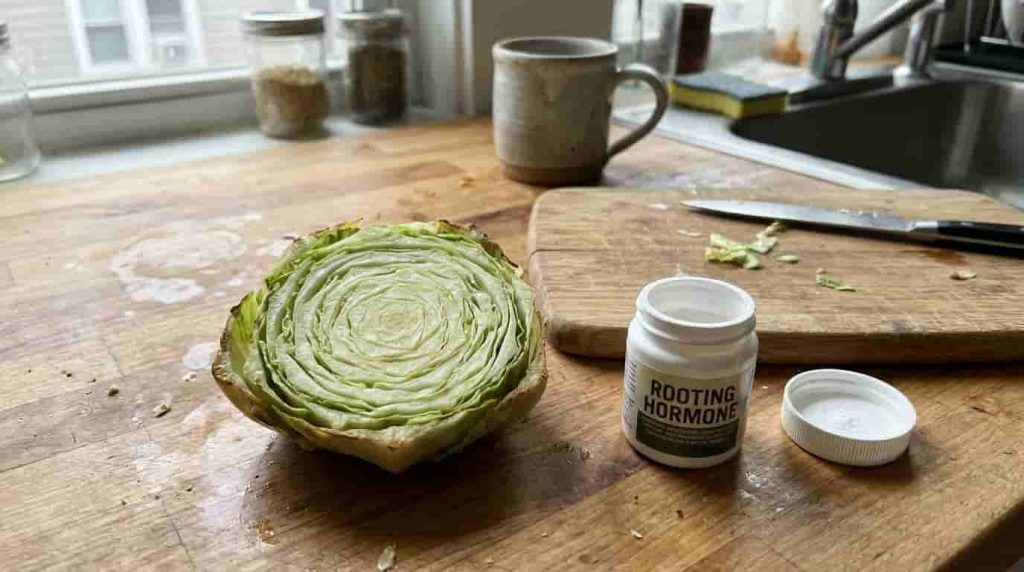
Use a clean, sharp chef’s knife to leave at least 2 to 3 inches of the romaine lettuce base intact. Look closely at the center crown—you want to see tightly packed, pale-yellow inner leaves where active leaf regeneration happens.
Next, shave a thin 1/4-inch slice off the very bottom of the brown, oxidized stem. Exposing fresh, white vascular tissue lets the stump absorb soil moisture right away instead of sitting sealed off by scar tissue.
Step 2: Apply Rooting Hormone (Optional, High Success Rate)
Dip the freshly cut bottom into a small pinch of powder rooting hormone containing indole-3-butyric acid (IBA) at 0.1% concentration. Shake off any excess powder so you don’t clog the stem’s pores.
While romaine can form adventitious roots on its own, IBA speeds up root development by 3 to 5 days. Faster roots mean your stump establishes before indoor fungi have a chance to attack the cut surface.
Step 3: Plant at the Exact Depth
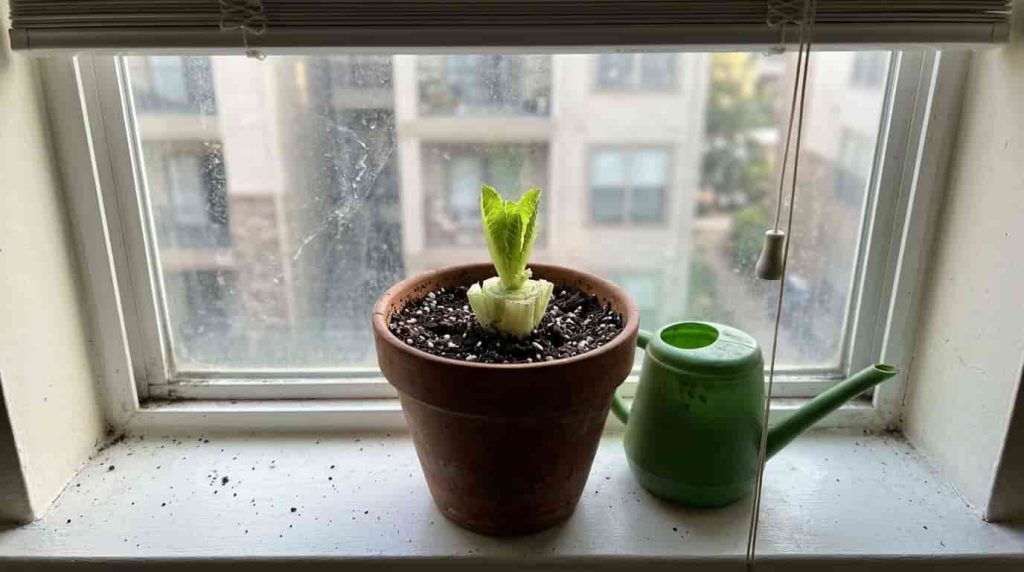
Fill your container with pre-moistened potting mix and press a shallow 1-inch depression in the center with your thumb. Set the romaine stump upright so the bottom 1 inch is buried, leaving the top 1 to 2 inches and the center heart completely above the soil line.
Gently firm the soil around the base to eliminate air pockets around the stem. Never bury the center crown of a romaine stump, because trapped soil moisture inside the leaf folds triggers instant stem rot.
Indoor Apartment Lighting, Temperature, and Container Specs
Apartment windows can be tricky, especially when neighboring buildings block half the sky. Getting your microclimate right determines whether you harvest crisp, sweet greens or pale, floppy leaves.
Indoor Lighting: PPFD, Foot-Candles, and Window Orientation
Romaine lettuce (Lactuca sativa var. longifolia) is a moderate-light crop that thrives on 12 to 14 hours of bright light daily. If you’re measuring with a light meter or smartphone app, aim for a Photosynthetic Photon Flux Density (PPFD) of 150 to 250 µmol/m²/s, which roughly equals 1,000 to 1,500 foot-candles (Source: USDA/University Extension).
-
South-Facing Windows: Best natural choice in US apartments. Set the pot 6 to 12 inches back from the glass in summer so direct midday heat doesn’t scorch the leaves.
-
East-Facing Windows: Great for cool morning sun and partial sun exposure. You’ll get steady, sweet growth without overheating the container.
-
West-Facing Windows: Intense afternoon heat can trigger early bolting. Pull the pot 18 to 24 inches away from the glass or filter the light with a sheer curtain.
-
North-Facing Windows: Too dim for strong leaf regeneration. Pair your pot with a full-spectrum LED grow light (4000K to 5000K) suspended 8 to 12 inches directly above the leaves.
Temperature and Humidity Thresholds
Lettuce is a cool-season crop that hates stuffy, overheated rooms. Keep your apartment growing spot between 60°F and 70°F during the day and 50°F to 60°F at night.
Once ambient temperatures climb past 75°F for several days in a row, the plant shifts from leaf production to survival mode and sends up a bitter seed stalk. Aim for 50% to 70% relative humidity—if your winter radiator drops apartment air below 35%, group your lettuce pot near other houseplants to create a slightly humid microclimate.
Container Sizes and Drainage Mechanics
Skip tiny 3-inch nursery cups that dry out by lunchtime. Plant each romaine stump in a container that is 6 to 8 inches wide and at least 6 inches deep, giving the fibrous root system room to spread out and hold steady moisture.
Make sure your pot has at least three 1/2-inch drainage holes in the bottom paired with a removable catch saucer. Terracotta pots wick away excess moisture and help prevent root rot in humid apartments, while food-grade plastic or glazed ceramic pots hold water longer if you tend to forget watering days.
Best Soil Mix and Fertilizing Schedule to Regrow Romaine Lettuce in Soil Without Water First
Bagged garden topsoil from a hardware store is way too dense for indoor pots. When you regrow romaine lettuce in soil without water first, your substrate needs to stay evenly damp while letting oxygen reach those brand-new root hairs.
Custom Apartment Potting Mix Recipe (By Cups)
Mix your own lightweight, well-draining soil in a mixing bowl or bucket using this 8-cup batch (enough to fill two 6-inch pots):
-
4 cups peat-free coco coir or high-quality organic potting mix (moisture base)
-
2 cups screened organic compost (slow-release nutrients and beneficial microbes)
-
1 cup coarse perlite or pumice (permanent aeration pockets)
-
1 cup worm castings (gentle nitrogen boost without burning tender new roots)
Before planting, add 1 to 1.5 cups of lukewarm tap water to the dry mix and stir it with your hands until it feels like a wrung-out sponge. Pre-moistening prevents water from channeling straight down the sides of the pot without soaking the center.
Ideal Soil pH and Aeration Elements
Romaine lettuce absorbs nitrogen, calcium, and magnesium most efficiently at a slightly acidic to neutral soil pH between 6.0 and 6.8 (Source: [Insert Link to USDA/University Extension]). If your soil drops below 5.5, calcium gets locked out and your new leaves develop brown, papery edges.
Perlite does the heavy lifting for indoor drainage, keeping fine compost particles from compacting into mud after three weeks of watering. If you prefer a darker soil look, swap half the perlite for 1/8-inch pine bark fines to maintain steady airflow around the stump.
Month-by-Month NPK Fertilizer Schedule
Because a regrown romaine stump is already a mature plant finishing its biological lifecycle, you won’t fertilize it for six months like a houseplant. Here’s the exact feeding timeline from planting to final harvest:
-
Month 1 (Days 1–14 — Root Establishment): Apply zero synthetic fertilizer. High salt levels burn delicate new root hairs; the worm castings and organic compost in your mix provide everything the stump needs.
-
Month 1 (Days 15–30 — First Leaf Surge): Once you see 2 inches of new green growth, feed once every 10 days with a liquid organic high-nitrogen fertilizer like fish emulsion (5-1-1) or seaweed kelp extract, diluted to quarter strength (roughly 1/4 teaspoon per quart of water).
-
Month 2 (Days 31–60 — Sustained Outer Leaves Harvesting): Continue quarter-strength balanced liquid organic fertilizer (such as 3-2-3 or 4-2-3) every 14 days. This keeps leaf regeneration steady without pushing salt buildup in a small apartment pot.
-
Month 3 (Days 61+ — Bolting Transition & Reset): Stop fertilizing as soon as the central stem elongates upward. Harvest the final leaves before they turn bitter, compost the spent stump, and start a fresh store-bought romaine base in refreshed soil.
Seasonal Care and Watering When You Regrow Romaine Lettuce in Soil Without Water First
Watering kills more regrown lettuce stumps than anything else. When you regrow romaine lettuce in soil without water first, your watering style has to match both the stump’s rooting stage and the season outside your apartment window.
The First 7 Days: Mist, Don’t Drench
For the first 4 to 5 days after planting, your stump has no active roots to drink up heavy pools of water. Instead of pouring a full cup of water over the pot, lightly mist the soil surface around the stump once a day with a spray bottle to keep the top 1/2 inch damp.
Around Day 6 or 7, gently tug the stump—if you feel slight resistance, root hairs have gripped the soil. Now you can switch to regular, thorough bottom or edge watering.
Tactile Moisture Testing and Drainage Management
Never water on a rigid calendar schedule like “every Tuesday.” Use the 1-inch knuckle test instead: poke your index finger 1 inch into the potting mix near the pot’s rim.
If the soil feels cool and sticks to your finger, wait another day. If it feels dry and crumbly at that 1-inch mark, water slowly around the outer rim (keeping water out of the center leaf crown) until a few drops exit the drainage holes, then empty the catch saucer after 10 minutes. Standing water in a catch saucer suffocates indoor lettuce roots in less than 24 hours.
Spring & Summer Active Growth vs. Fall & Winter Apartment Care
-
Spring & Summer (High Light, Warm Rooms): Longer days and warmer windowsills speed up evaporation and push rapid leaf growth. Check soil moisture daily, run a small oscillating fan on low to keep air moving past the leaves, and pull pots away from hot afternoon glass so your romaine doesn’t bolt by Week 3.
-
Fall & Winter (Short Days, Dry Radiator Heat): Natural daylight drops sharply across most US states, slowing growth to a crawl. Water only every 3 to 5 days, supplement with an LED grow light for 12 hours a day, and keep your pot at least 4 feet away from baseboard heaters or forced-air vents that parch tender leaf tips.
Read More: Best Shelving for Indoor Vegetable Garden: The Ultimate 2026 DIY Wire Rack Blueprint
Direct-to-Soil vs. Water-First: Comparison Table
Not sure if skipping water is right for your kitchen setup? Here’s how the four most common ways to grow romaine indoors stack up side by side.
| Growing Method | Rot Risk | Days to First Harvest | Flavor & Yield Potential | Best Apartment Setup |
| Direct-to-Soil (No Water First) | Low | 14–21 days | Mild, crisp leaves; 6–10 sandwich-sized leaves before bolting | Bright windowsill or LED light + 6-inch pot |
| Direct-to-Soil + Rooting Hormone | Very Low | 12–18 days | Strongest early root grip; steady outer leaves harvesting | Cool room (62°F–68°F) + organic compost mix |
| Shallow Dish of Water First | High | 10–14 days (in water) | Watery, pale leaves; high transplanting shock if moved to soil | Quick 1-week zero food waste experiment with kids |
| Seed-Grown Romaine (Lactuca sativa) | Very Low | 45–60 days | Full, dense head; sweet flavor; longest harvest window | Dedicated LED grow light + 8-inch deep planter |
Always harvest the outer leaves first with clean scissors, leaving the central heart intact so the plant keeps pushing fresh shoots.
Apartment Gardening Myths Debunked: The Botany Behind Leaf Regeneration
Social media gardening clips love promising endless free groceries from one lettuce butt. Understanding the actual plant biology saves you a ton of disappointment and keeps your indoor garden productive.
Myth 1: A Regrown Romaine Stump Will Grow a Full, Dense Grocery-Store Head
Viral posts often claim you’ll get a brand-new, tightly packed head of romaine in three weeks. Botanically, that almost never happens with a store-bought romaine stump.
When a commercial farm harvests romaine, the plant has already completed its vegetative rosette stage and stored energy toward reproduction. Cutting off the outer leaves triggers the apical meristem (the central growing point) to push out a rapid burst of loose, 4-to-6-inch leaves.
Shortly after—usually between Weeks 3 and 5—the plant senses heat or day-length stress and initiates bolting (sending out a tall central seed stalk). As soon as bolting starts, Lactuca sativa pumps a bitter, white milky sap called lactucarium through its leaves to deter pests while it flowers. Enjoy your regrown romaine for crisp sandwich toppings and mini salads, then start a new stump or sow seeds for full heads.
Myth 2: Adding Pebbles or Gravel to the Bottom of Your Pot Improves Drainage
Generations of apartment gardeners were told to drop an inch of rocks into the bottom of a pot before adding soil. Soil physics proves this does the exact opposite.
Water moves easily through fine potting mix, but it refuses to cross into coarse gravel until the soil layer directly above the rocks is 100% saturated. This creates a perched water table that raises the soggy, oxygen-starved zone closer to your romaine stump’s roots, speeding up root rot. Fill the entire pot from top to bottom with uniform, perlite-aerated potting mix instead (Source: [USDA/University Extension]).
Advanced Troubleshooting and Indoor Pest Diagnostics
Even with a solid setup, indoor air and tight containers can throw curveballs. Catching stress early lets you rescue the plant before the stump collapses.
Yellowing Lower Leaves (Chlorosis)
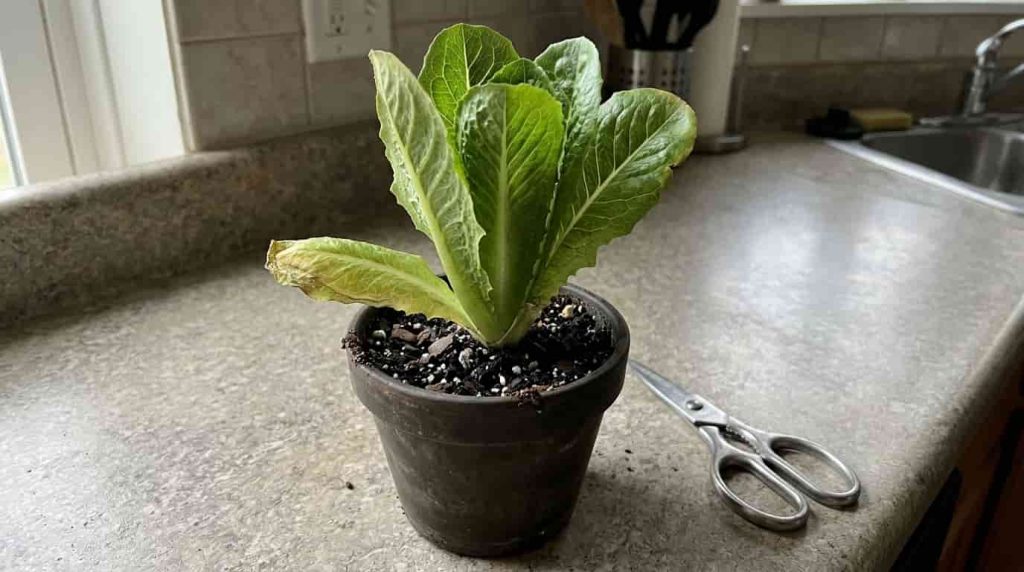
If the oldest outer leaves turn pale yellow and soft, check soil moisture first. Soggy, sour-smelling soil means early root rot—stop watering, move the pot to brighter airflow, and trim away mushy outer leaves so rot doesn’t spread to the stem.
If the soil moisture feels right and the pot drains cleanly, your plant is hungry for nitrogen. Give it a quarter-strength dose of liquid fish emulsion (5-1-1) at your next watering.
Crispy Brown Tips (Tipburn)
Brown, scorched margins on the newest inner leaves are classic tipburn, a calcium transport disorder—not usually a lack of calcium in the soil. Because calcium travels strictly through water moving up the plant (transpiration), stagnant apartment air or wildly inconsistent watering stops calcium from reaching fast-growing leaf tips.
Keep soil moisture steady and set a small desk fan nearby on low for 2 to 3 hours a day to gently rustle the leaves and drive transpiration.
Leggy, Stretched Growth (Etiolation)
Are your new romaine leaves growing long, skinny, pale-green stems that flop over the rim of the pot? That’s etiolation—the plant is literally stretching in search of photons.
Move the pot immediately to a brighter south-facing windowsill or place a full-spectrum LED grow light 8 inches above the foliage for 14 hours daily. Trim off the weak, flopped leaves so the plant redirects energy into compact new shoots.
Powdery Mildew
White, dusty patches that look like spilled flour on the upper leaf surfaces point to powdery mildew fungi. It thrives in cool indoor rooms with poor air circulation and damp foliage.
Snip off infected leaves right away and drop them in the trash (never your compost). Increase airflow with a fan and avoid misting the leaves once roots are established; if spots persist, spray the foliage lightly with a mix of 1 teaspoon baking soda, 1/2 teaspoon mild liquid castile soap, and 1 quart of water.
Fungus Gnats
Tiny black flies hovering around your potting mix mean your topsoil stays too wet for too long. Their larvae feed on decaying organic matter and tender new lettuce root hairs.
Let the top 1/2 inch of soil dry out between waterings, place yellow sticky traps right at the pot rim to catch adults, and water once with a biological larvicide containing Bacillus thuringiensis israelensis (BTI, commonly sold as Mosquito Bits) soaked in your watering can. Dry topsoil breaks the fungus gnat breeding cycle faster than any chemical spray.
Spider Mites
Fine webbing underneath the leaves paired with tiny yellow speckles signals spider mites, which explode in hot, dry winter apartment air near radiators. Rinse the leaves thoroughly under lukewarm tap water in your kitchen sink to knock off the mites and eggs.
Follow up by wiping the undersides of the leaves with a diluted insecticidal soap spray safe for edibles, repeating every 5 days for two weeks until the webbing disappears.
Read More Article: Growing Lettuce on Windowsill in Water: An Exhaustive Guide for Apartment Dwellers
Frequently Asked Questions
Can I really regrow romaine lettuce in soil without water first if the store-bought base looks brown?
Yes, as long as the core inside feels firm and isn’t mushy or slimy. Use a sharp knife to shave off the bottom 1/4 inch of brown, oxidized tissue until you see crisp white stem underneath. That fresh cut lets the romaine stump pull in moisture and form new root hairs directly in damp potting mix.
How long does it take to regrow romaine lettuce in soil without water first?
You’ll typically spot tiny new leaves emerging from the center heart within 3 to 5 days of planting. Root hairs grip the potting mix around Day 6 to 8, and your first batch of outer leaves will be 4 to 6 inches tall and ready to snip in 14 to 21 days. Using a pinch of IBA rooting hormone can shave 3 to 4 days off that timeline.
Why did my regrown romaine lettuce turn bitter so quickly?
Bitterness happens when the lettuce enters its bolting phase and produces a milky white sap called lactucarium. Warm apartment rooms above 75°F, erratic watering, or leaving the plant past Week 4 trigger this shift. Keep your pot in a cool 60°F to 70°F spot and harvest outer leaves while they’re young and tender.
Is regrown romaine lettuce safe if my cat or dog nibbles on the pot?
Yes, romaine lettuce (Lactuca sativa) is 100% non-toxic to both cats and dogs according to veterinary toxicology references. Eating a large pile of fibrous leaves can occasionally cause mild stomach upset, so moderation is still smart. If you use rooting hormone or organic fertilizers like fish emulsion, keep pets away from the soil surface so they don’t ingest concentrated garden products.
Can I reuse the same potting soil for my next romaine lettuce stump?
You can reuse the soil once if your previous plant stayed completely free of root rot, powdery mildew, and fungus gnats. Scoop out the old rootball, fluff the mix, and blend in 1 cup of fresh worm castings or organic compost to replace spent nitrogen. If your last stump rotted or had pests, discard the soil and wash the pot with warm soapy water before starting fresh.
Do I need grow lights to regrow romaine lettuce indoors during winter?
In most US apartments, winter daylight through a window isn’t strong enough to reach the 150 to 250 µmol/m²/s PPFD that romaine needs for crisp growth. Without supplemental light, your leaves will turn pale, thin, and leggy within two weeks. A simple 15-to-20-watt full-spectrum LED bulb positioned 8 to 12 inches above the pot for 12 to 14 hours daily solves the problem easily.
Learning how to regrow romaine lettuce in soil without water first turns everyday kitchen scraps into crisp, zero-waste harvests right on your apartment windowsill. Skip the slimy water bowl, give that fresh-cut stump an aerated potting mix, steady cool temperatures, and bright light, and you’ll be snipping homegrown sandwich greens in under three weeks. Grab a 6-inch pot after dinner tonight and put your next romaine base straight to work.